Risk and Reward
Posted on Oct. 13, 2025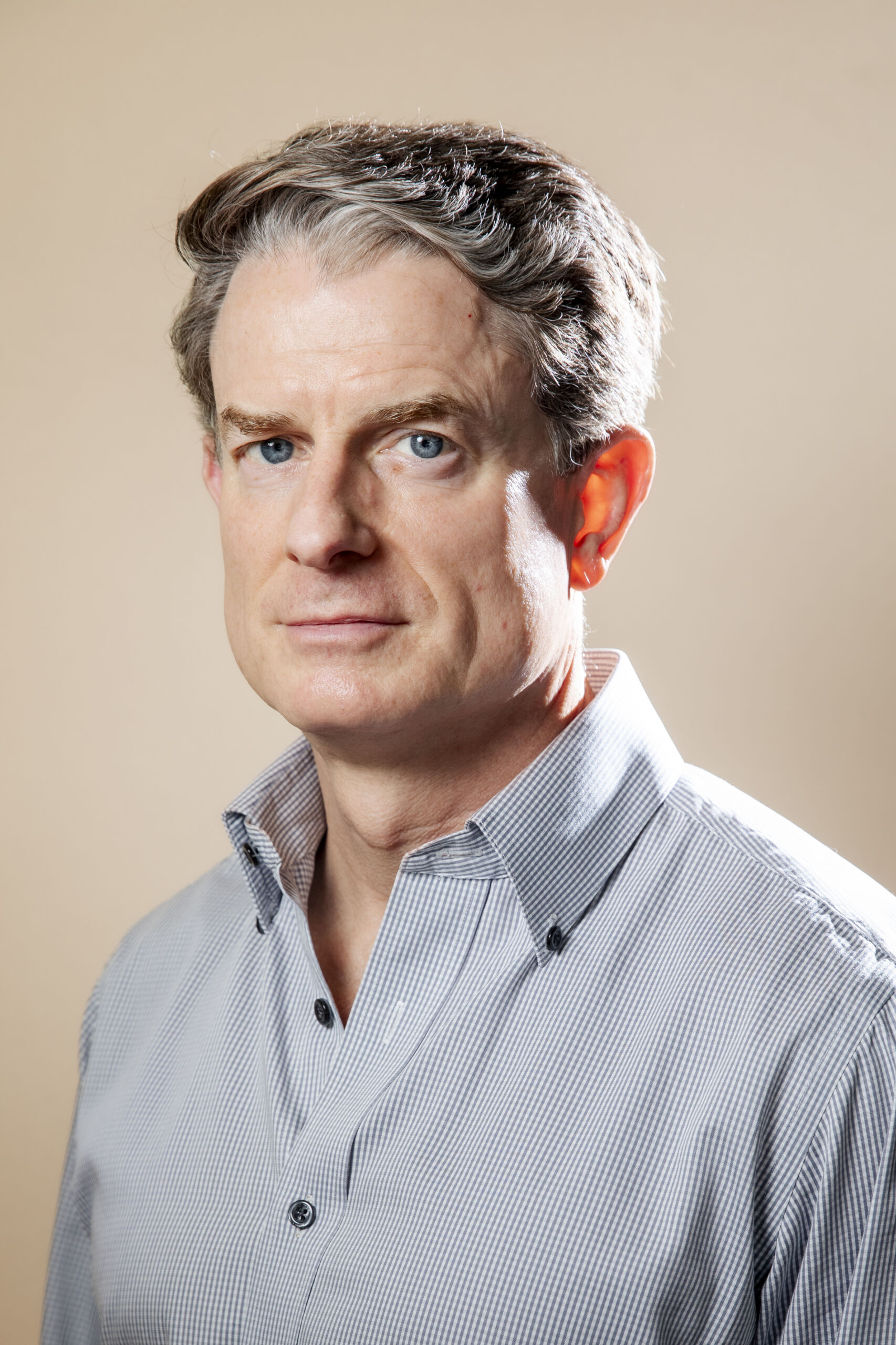
Coleman Cowan ’92 has received Emmy, Gracie, Murrow, Peabody and Polk awards for broadcast journalism and has reported from Africa, Asia, Australia, Europe, and North and South America. His print stories have appeared in BusinessWeek magazine, The New York Times, the Columbia Journalism Review, the Albany Times-Union and The News & Observer. (Photo: Carolina Alumni/Ira Wilder ’24)
Make no mistake. Coleman Cowan ’92 would never say he was glad he was shot. But if it weren’t for that unfortunate event on Feb. 24, 1999, he said, a career full of adventure and risk would have never come along — and he might have never learned the best lessons are often found in the biggest leaps.
On that February day, Cowan was a 28-year-old Durham attorney, arriving a little too early to a doctor’s office where he was scheduled to take a deposition. As he waited in his car, he took stock of the career he’d barely begun: the long hours, the stress, the traveling just to see the insides of hotels and conference rooms. Would being a trial lawyer feel like this forever? Cowan shook off the introspection and went to work, but that evening, while he was talking with another attorney in a parking lot, a teenager approached on a bicycle, asked for money and then shot them both.
Each survived, though a bullet shattered Cowan’s radius bone in his forearm and severed his median nerve. It took multiple surgeries and a titanium plate to fix it, but he never fully regained use of his hand. As Cowan recovered, he felt detached from the world and worried he would burn out as a lawyer. He reassessed his priorities and realized he needed a different kind of profession, one in which he could feel more connected to the world around him and tell stories, not unlike the harrowing one he had just experienced. Journalism came to him. At the age of 35, he decided to leave law and start over in an industry in which he had no experience.
Some of his colleagues called it a “monumentally foolish decision,” he recalled, but he had key support from his parents and his then-girlfriend, now wife, Angie Abernethy Cowan.
“As a journalist, your job is to be immersed in the world,” Cowan said. “It all sounded grand and wonderful, to stop practicing law and go explore this thing.”
Where he needed to be
It didn’t start out grand. Cowan, who had majored in economics at Carolina, had a college friend working at Businessweek magazine in Atlanta, but to trade the courtroom for the newsroom, he’d have to start at the bottom. He walked away from a comfortable, steady career to make coffee, fix fax machines and chase news clips.
But once his bosses gave Cowan a shot at writing and reporting, he was hooked. When Hurricane Katrina hit, his editor sent him to New Orleans to cover the school system. It was a moment he’d never forget, driving along the Pontchartrain Expressway as the sun rose over the Mississippi River and realizing he was exactly where he needed to be. “That’s the moment when it clicked for me,” he said. “I thought, I can’t believe my job. I get to be in this corner of the world, seeing this thing that few would experience.” That “monumentally foolish decision” to leave his law career was paying off in his heart.
It didn’t start out grand. To trade the courtroom for the newsroom, Cowan would have to start at the bottom. He walked away from a comfortable, steady career to make coffee, fix fax machines and chase news clips.
After a year at Businessweek, Cowan pursued a master’s degree in journalism at Columbia University, during which his master’s project was an investigative piece on how the New York Police Department stored and maintained criminal evidence in warehouses scattered across the city, using a paper voucher system. The story attracted interest from a producer at 60 Minutes.
“All of a sudden, I’m interviewing for a job at 60 Minutes, knowing nothing about broadcast journalism,” Cowan said. “Once again, it was a foot in the door of something I had no experience in.”
Cowan, 37 at the time, took an entry-level job as an editorial assistant conducting research, chasing tape in the CBS archives and doing whatever he was told. But just like he did at Businessweek, he put his head down, made friends, asked questions and absorbed lessons on the art of storytelling from greats such as then-Executive Producer Bill Owens and veteran correspondents Steve Kroft and Scott Pelley. “Bill Owens was very patient with me as this new producer who didn’t have a background in television, who was trying to figure out how to tell a story,” Cowan said. “I had the pieces, but he helped me put it together: ‘This is how you engage an audience, how you keep it honest.’ ”
He quickly rose to associate producer and then a producer for Kroft. He won an Emmy for a package on the connection between untreated mental illness and mass shootings. For other segments, he climbed mountains with disabled veterans and rode in the back of a Black Hawk helicopter. He traveled to Afghanistan, Australia and the Amazon. “Many moments throughout that time,” Cowan said, “I was thinking, I can’t believe that here I am doing this, and this is my job.”
Carolina calling
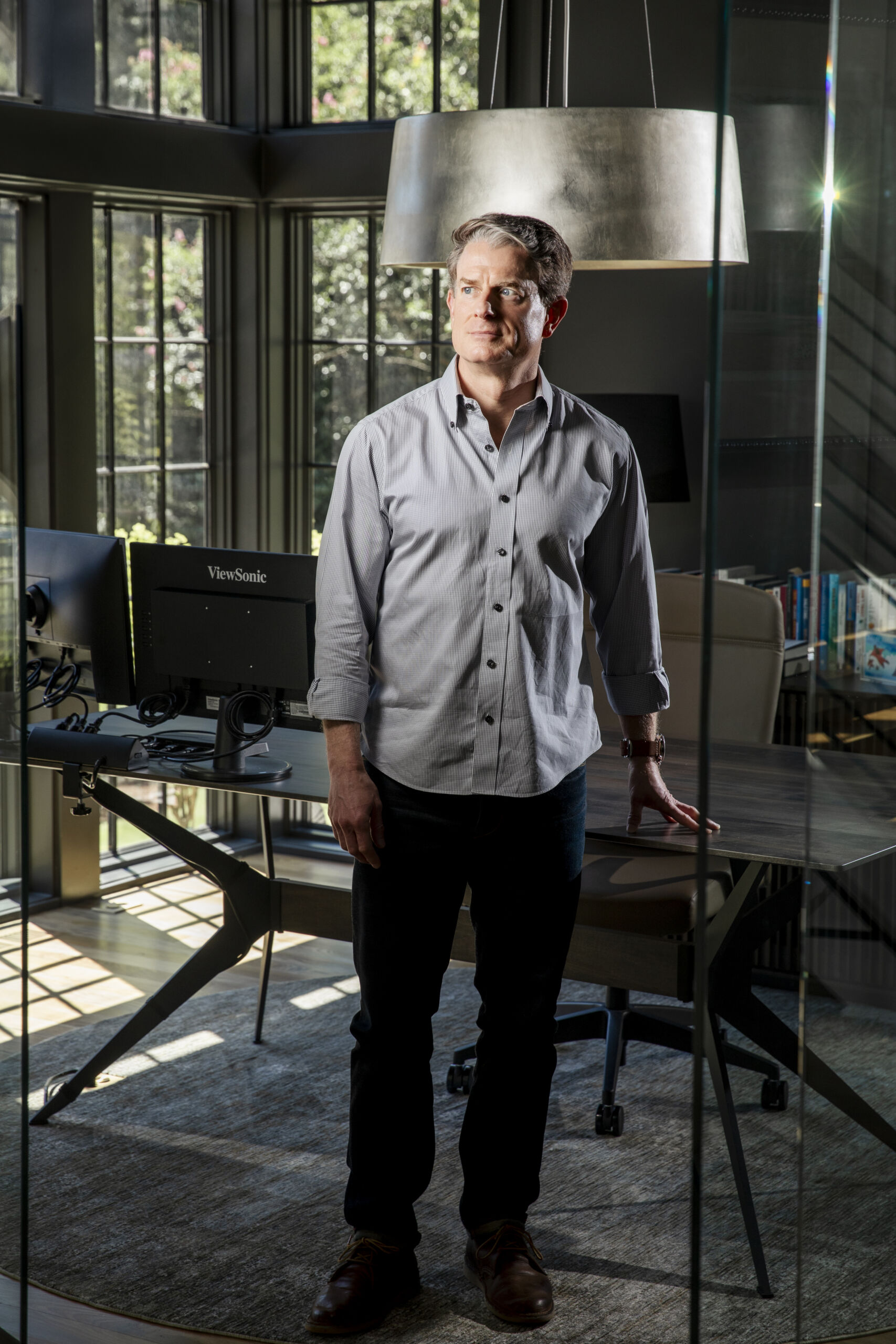
(Photo: Carolina Alumni/Ira Wilder ’24)
Over the years, the Cowans kept North Carolina in their minds. They wanted to raise their son there and be closer to family and friends back home. Although Cowan had kept his law license current during the 12 years after he left the profession, returning to the courtroom was the last thing on his mind — until his friend and mentor Hoyt Tessener came calling. Tessener had recently revamped the litigation department at the Law Offices of James Scott Farrin, one of the largest personal injury firms in the state, and he told Cowan he wanted him to lead the department. After thinking it over and doubting whether he could, or should, make another career jump, Cowan decided to join Tessener. “I think I needed to prove something to myself that I could do it again, maybe a little better,” he said. Four weeks after he left 60 Minutes, he was back in the courtroom, which he said was a scary but defining moment.
Cowan said he could see his career come together. He could lean on what he’d learned as a journalist and a storyteller to be a better trial lawyer for injured families in need of representation. He’d been telling stories for millions of viewers at 60 Minutes and realized he had everything he needed to make that emotional connection with 12 jurors.
Seven years later, Cowan remains at the law firm, and in 2024 he became a senior lecturing fellow at Duke University, where he teaches pretrial litigation and mentors students.
When you’re young, he said, it looks as if things came easy for those you look up to. But that’s not true.
It shouldn’t have taken a bullet, Cowan said, to make a big life change and then have the confidence to do it over and over again. “I didn’t want to be in my mid-50s and look back and regret not making a change or not exploring something.”
Cowan said he’s glad he left lawyering in his 20s for a different kind of career. “I am a much better lawyer, much happier lawyer, much happier person, much more fulfilled person, a more well-rounded person, probably a better husband and a better father,” he said. It’s important to take risks in life, he said, knowing that you could fail, “because it’s the only way to get better at what you do.”
Courtney Jones Mitchell ’01 is a freelance writer based in Chapel Hill.
Thanks for reading the Carolina Alumni Review
Carolina Alumni members, sign in to continue reading.
Not yet a member? Become one today.