The Keyes to the Kingdom
Posted on Sept. 22, 2026William Keyes IV ’75 (’18 PhD) inspires young Black men to become leaders in service to others.
by John Bare ’87 (’92 MA, ’95 PhD)
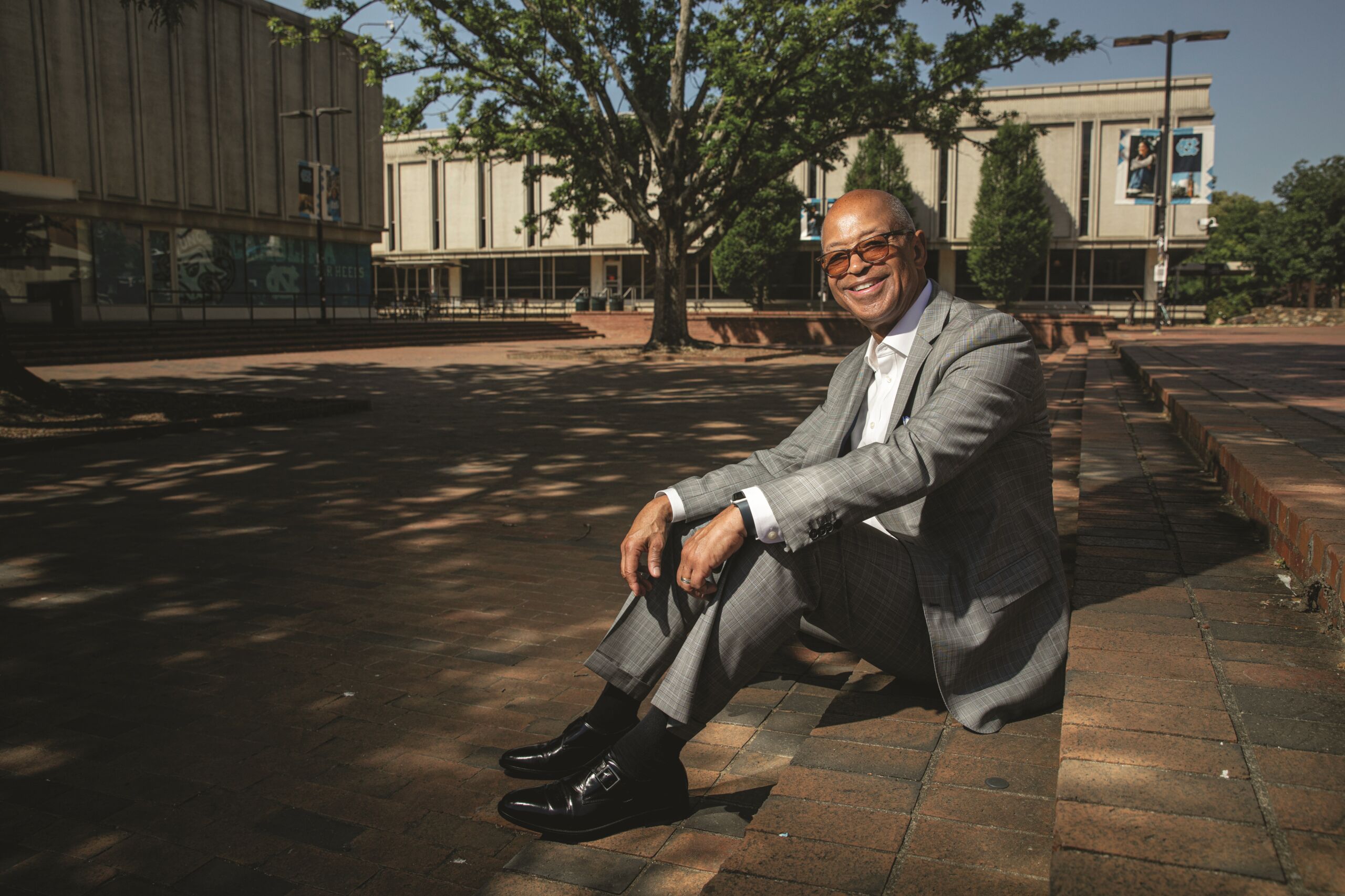
Keyes, a man of faith, found a calling more than 20 years ago when he observed how few young Black men were part of the Washington, D.C., programs that produce a reliable queue of students for elite leadership posts. His creation, the Institute for Responsible Citizenship (IRC), became part pulpit and part classroom. (Photo: Carolina Alumni/Ira Wilder ’24)
William Keyes IV ’75 (’18 PhD) devoted his undergraduate years to cultivating a superpower that would carry him to the White House, propel him to the forefront of a national debate about merit and achievement and inspire him to spend a decade completing a doctorate — a feat that added a unique superlative to his already decorated bio: He’s the only person in the University’s 234-year history to earn a doctoral degree while serving on the Board of Trustees.
In scholarly terms, Keyes became a student of rhetoric. In a practical sense, he learned how to talk to people in ways that lift them up. Tar Heel basketball legend Phil Ford ’78, a close friend since their days on campus, has experienced the uncommon joy that arises from conversations with Keyes. “He’s like Coach Smith,” Ford said. “He never forgets a name. We talk about a lot of things, not just basketball. He makes you feel very comfortable to be around. You can sit and talk for hours, and he makes you feel good.”
Over the years, in and out of classrooms, Keyes has examined how our use of language shapes interpersonal relationships and, in turn, how the nature of our relationships can open or close pathways. In opposition to the huckster’s use of language for personal gain, Keyes explores how combinations of words, delivered just so, can produce benefits for others. In his doctoral research, Keyes investigated how Benjamin Mays, a minister and president of Morehouse College from 1940 to 1967, used language to give “his students vivid, specific, positive images of the Morehouse Man.” By “offering them an alternative vision of themselves and their possibilities in life,” Mays enabled the students to overcome Jim Crow’s imagery of Black men.
The Institute for Responsible Citizenship
300+ scholars since 2003
6 Rhodes Scholars
9 Truman Scholars
2 Fulbright Scholars
15 Harvard Law graduates
1 Harvard Divinity graduate
4 Harvard Business School graduates
3 Yale Law graduates
6 Yale Divinity graduates
2 Yale Business School graduates
21 PhD recipients
5 medical doctors
4 professors
23 years of impact
Keyes, a man of faith, found a calling more than 20 years ago when he observed how few young Black men were part of the Washington, D.C., programs that produce a reliable queue of students for elite leadership posts. His creation, the Institute for Responsible Citizenship (IRC), became part pulpit and part classroom. In its flagship program, IRC hosts men over two summers during college, immersing the participants — “scholars,” in IRC parlance — in internships, mentoring relationships and seminar programs. Situated in Northwest D.C. near Rock Creek Park and just north of Foggy Bottom, the IRC positions men in proximity to public and private centers of power, from the State Department to Georgetown University to any number of embassies and think tanks. It’s a short walk — think Morehead Planetarium to Kenan Stadium — from the IRC to the 148-year-old Cosmos Club, an exclusive social club where membership rolls have included three presidents, 14 Supreme Court justices and 36 Nobel Prize winners. Keyes draws on a lifetime of relationships to open this world to the scholars. To date, the IRC has produced more than 300 graduates.
As a latter-day Mays, Keyes uses language and immersive experiences to change the way the young Black men see themselves and their place in the world.
“It turned out to be one of the great blessings of my life,” Rakim Brooks said of his summers in D.C. He is one of five IRC alumni to win a Rhodes Scholarship. There are also Truman Scholars and professors, doctors, lawyers, pastors, artists and one New York state Supreme Court justice.
Brooks, who grew up in Harlem, is a first-generation college graduate who holds degrees from Brown, Oxford and Yale and earlier this year joined the Ford Foundation as senior adviser to the president. He credits an IRC professor with expanding his sense of what is possible. “I wouldn’t have won a Rhodes Scholarship without him,” Brooks said.
The origin of things
A famous observation by Charles Kuralt ’55 explains Keyes’ undergraduate experience. It wasn’t the well or the bell or the stone walls that made Carolina special for him. It was the people — thousands of people, from every imaginable city and town. Keyes met as many as he could. Through serial conversations, he unraveled the communications secret that shapes political outcomes and social fortunes. He discovered the power of demonstrating an authentic, ardent interest in the person with whom he is speaking.
The middle child of public school teachers in Washington, N.C., Keyes arrived on campus obsessed with becoming a football coach. “I was reading everything I could about coaching, coaching philosophy, technique,” he said. “I would go to clinics. I would even go to places and stand on the sidelines and watch how coaches were organizing and managing their practices.”
Then two things happened that set him on a new path. One was a revelatory political science class on Southern politics. “It changed everything,” Keyes said. “I slammed on the brakes and said, ‘I’m not doing football coaching. I’m doing politics.’ ” A half-century later he remembered how the rhetoric of the political speeches stirred something. By the end of the semester, he was set on politics.
Second, Keyes discovered the Pit, a living laboratory of rhetorical studies full of the “greatest lessons” of his life. “I would sit in the Pit and talk to people all day. It’s funny. Years later, I’d meet somebody who was in school around the same time I was, and they’d say, ‘Well, what did you major in?’ I’d say, trust me, you don’t know me from that. I was in the Pit. The benefit of the time I spent in the Pit was, years later, I could walk into a room with six United States senators, four corporate CEOs, whoever, and it wouldn’t faze me to go and engage those people.”
After college, armed with freelance writing experience and a stint working on the campaign of U.S. Senate candidate Lawrence Davis, who lost in the 1978 Democratic Party primary, Keyes hitchhiked from Chapel Hill to D.C. with $5 in his pocket and a commitment to work in national politics. He was homeless for a period, and today he chuckles when students ask him about the apparent hardship. He recalls it as a grand time of boundless opportunity. He leaned on the rhetorical skills he had honed in the Pit.
Soon after arriving in Washington, he landed a job in the House of Representatives Post Office, where he worked from 2 a.m. to 8:30 a.m. From there, he would wash up in a men’s room, put on a coat and tie and spend mornings walking the halls of House and Senate office buildings. He shook every hand in sight. That led to a volunteer gig in a House member’s office, which occupied him from 9 a.m. to 3 p.m. Then from 3 to 5 p.m., he door-knocked congressional offices to introduce himself, chat up staff and leave a resume. For dinner, he crashed Capitol Hill receptions.
In the evenings, when his peers hit the bars, he sat in the Library of Congress “and read everything I could get my hands on about how Congress worked,” he said. “I’d sit there until they would kick me out of the library. Then I’d go into the Rayburn House Office Building. I would sit down on a big leather sofa, and I would sleep for two hours. I would look out the window, and I would see the Capitol Dome all lit up out there. I would sit there thinking, ‘Wow, that is the United States Capitol. Pretty important decisions get made in that building.’ ”
After several weeks, with savings from the post office job, he secured an apartment. It took longer to move from volunteer to paid staffer. Keyes had no luck calling on Democratic members. “None of them gave me the time of day,” he said. Then one of the Republican staffers he met through his networking offered him a job on the Senate Republican Policy Committee, which led to a job as a Republican staffer on the Joint Economic Committee.
“The next phone call I got was from White House presidential personnel,” Keyes said. “I ended up going to work for Ronald Reagan in the White House as a senior policy adviser. Three times I said to people, ‘But I am not a Republican.’ Then finally, I just thought, ‘Why do I keep trying to close doors that the Lord keeps opening for me?’ At that point, it’s like, ‘Who cares what they call me?’ That’s how I became a Republican.”
The origin story has become a parable for IRC scholars. “I try to teach young people: You don’t know who’s the person who’s actually going to be the one who’s going to help you,” Keyes said.
Commitment to the best and brightest
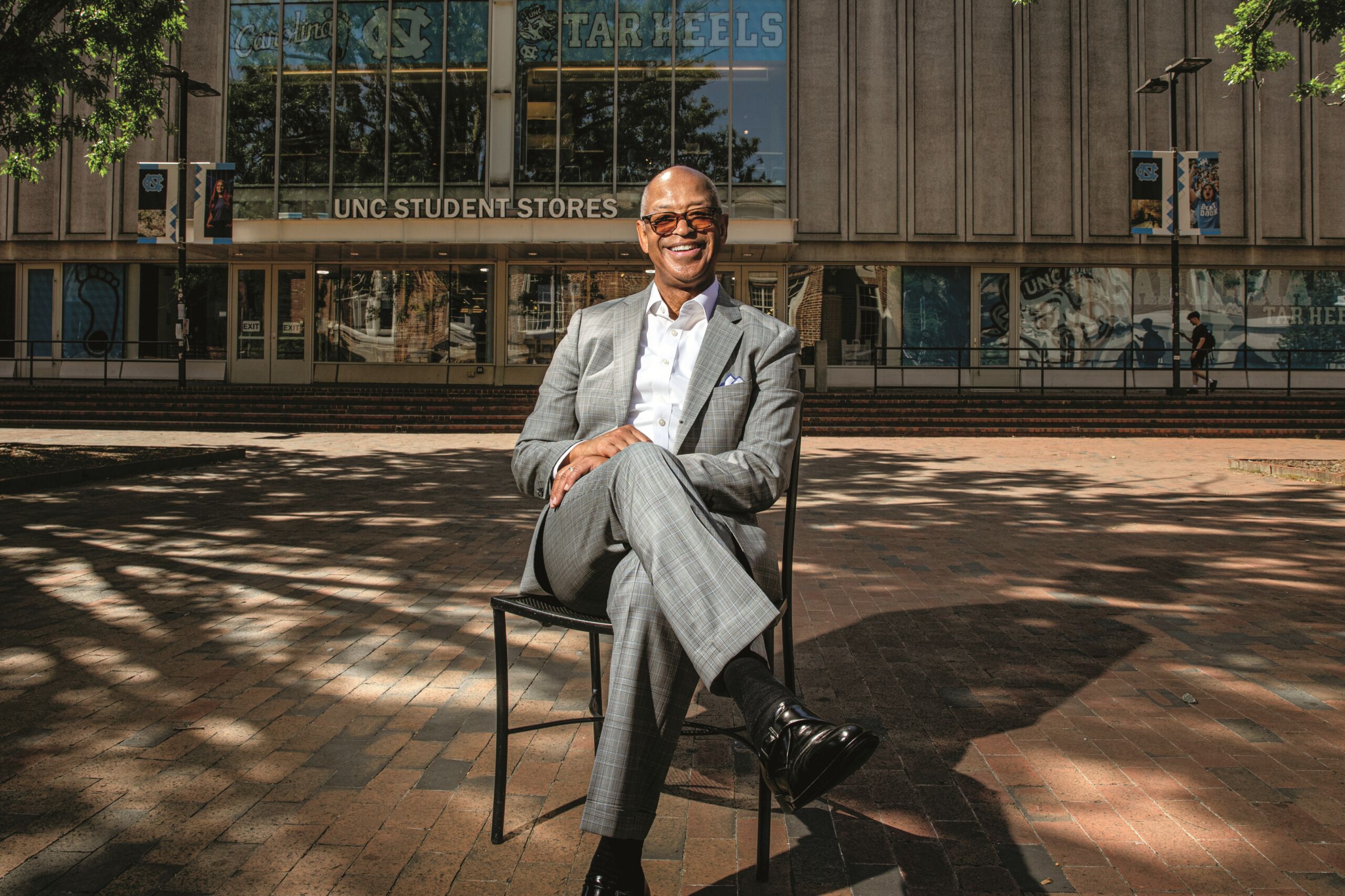
“I would sit in the Pit and talk to people all day. It’s funny. Years later, I’d meet somebody who was in school around the same time I was, and they’d say, ‘Well, what did you major in?’ I’d say, trust me, you don’t know me from that. I was in the Pit. The benefit of the time I spent in the Pit was, years later, I could walk into a room with six United States senators, four corporate CEOs, whoever, and it wouldn’t faze me to go and engage those people.” (Photo: Carolina Alumni/Ira Wilder ’24)
In IRC’s highly selective flagship program, which brings students to Washington for two summers, the institute leaders orient men to greatness as the norm. The title of Keyes’ 2025 book, The Stories They Hear: Expecting Greatness as the Key to Success, reveals the primary method. Over dinner, during classes, in casual conversation and in nearly every moment in between, Keyes tells stories to set high expectations for the scholars.
“At every orientation, first thing I say, and the first thing I say at every graduation, and I say it several times in between is: God has blessed every single one of us with something special. Our job is to try to figure out what that is, work hard to develop it and use it for his glory, and to be a blessing to other people,” Keyes said. “We talk about how we identify it. That’s hard.”
Colin Ganges graduated from the IRC in 2019. After working in politics as a speechwriter, he joined the institute staff and now directs the program. “We don’t shy away from saying that these are the best and the brightest, that we want people who are doing well academically, who are engaged on and off campus, people who we think are going to change their communities and change the world when they get older,” Ganges said. “That’s really our litmus test for who we want to accept into the program.”
The concentration of talent stirs the young men to pursue purposeful lives. “Iron sharpens iron, you know,” Brooks said. “Bill is kind of in your face. He speaks something into you that you may not see in yourself.”
For as long as he has been running the institute, Keyes has heard from critics who believe resources should go to needier students. The criticism revives a tension that W.E.B. Du Bois, Mays and others confronted when they called for investing in the best and brightest Black Americans based on the belief that the approach would ultimately lift up all Black Americans.
Du Bois wrote about his frustration with donors who declined to help college-bound Black students because, the donors argued, those students had reached a station where they could “be left to themselves to make their own way in the world.” Keyes, as did Du Bois, disagrees.
In his dissertation, Keyes reasoned that investing in scholars does not require short-changing other students. “As Du Bois put it, the problems of the many will be solved in part by the effort of the most talented, and supporting the exceptionally gifted does not mean reducing support for those who are not,” he said. “I seek to remind people that the purpose of preparing the most talented young people for success is to increase their capacity for leadership and service to others. Preparing one excellent teacher, preacher or doctor benefits the hundreds or thousands of students, parishioners or patients whose lives that teacher, preacher or doctor will touch over the course of their careers. The most talented individuals’ success is not enjoyed by them alone.”
Recent Supreme Court rulings and federal policy changes have reset the rules for nonprofit organizations devoted to serving particular groups of students. And while Title IX carves out exceptions so that private undergraduate institutions such as Wellesley College can serve only women, there is no similar accommodation for other types of education and leadership organizations. Keyes has expanded the IRC’s scope by adding a community-based program open to any student, and he has invited IRC alumni into discussions about the future of the flagship program.
Inspiration and obligation
Lawrence Brown, currently a surgery resident at The Johns Hopkins Hospital, majored in music and minored in chemistry at Oakwood University in Huntersville, Alabama, and was the first Oakwood student selected for the IRC. During his two summers in Washington, he met with all kinds of leaders, from Capitol Hill to the Supreme Court, and logged 600 hours shadowing orthopedic surgeons. “That experience was pivotal. I confirmed my calling to pursue a career as a physician,” said Brown, who holds graduate degrees from Meharry Medical College, Yale School of Public Health and Johns Hopkins School of Public Health. The IRC, he said, “fundamentally broadened my sense of what was possible and what leadership could look like.”
Ganges said young Black men carrying the best-and-brightest label are familiar with all that the designation carries. “I wouldn’t tell other people that they have an obligation, but my own personal view is I do think we have an obligation,” he said. “There are certainly a number of students who come to the institute with the idea of legacy.”
For Brown, “the experience was very clearly one of inspiration, not obligation. There was never a sense that we were required to give back in a transactional way. Instead, being surrounded by such driven, purpose-oriented peers created a shared ethos where we are inspired to reach back, support the next generation and contribute to building a better society.” Brown was moved by Keyes’ argument that IRC scholars can produce outsized impact. “The work we do carries a ripple effect, one that can ultimately impact countless lives.”
Keyes reinforces this message through stories about what it means to use personal gifts to benefit others. He reminds the men: “You’ve got to get all of this stuff — I get that — but the faster you can get from the getting mode to the giving mode, the happier you’re going to be.”
Elijah Heyward III ’18 (PhD), who was a Royster Fellow at UNC, was the first student to arrive when the IRC launched back in 2003. He now serves on its board and describes Keyes as “one of the single most important people in my life.” For Heyward, who provides strategic consulting for businesses and nonprofits, the IRC succeeds because Keyes creates conditions for scholars to “find that spark or light” that reveals their purpose. “There’s something really powerful about that,” he said. “It is less an obligation and more personal accountability affirmed by those around you. There is a commitment to service and a commitment to being part of a collective and wanting each other to succeed.”
Keyes’ son, William Keyes V ’21 (MBA), who goes by BJ, was a scholar in the institute and is now executive director of the organization, working alongside his dad. He attributes the institute’s impact to a design that blends “high expectations, mentorship and genuine community.” In a sense, it’s a hothouse of positive peer pressure. “It creates an environment where people genuinely know each other, support each other and push each other to grow.”
Thousands of my friends
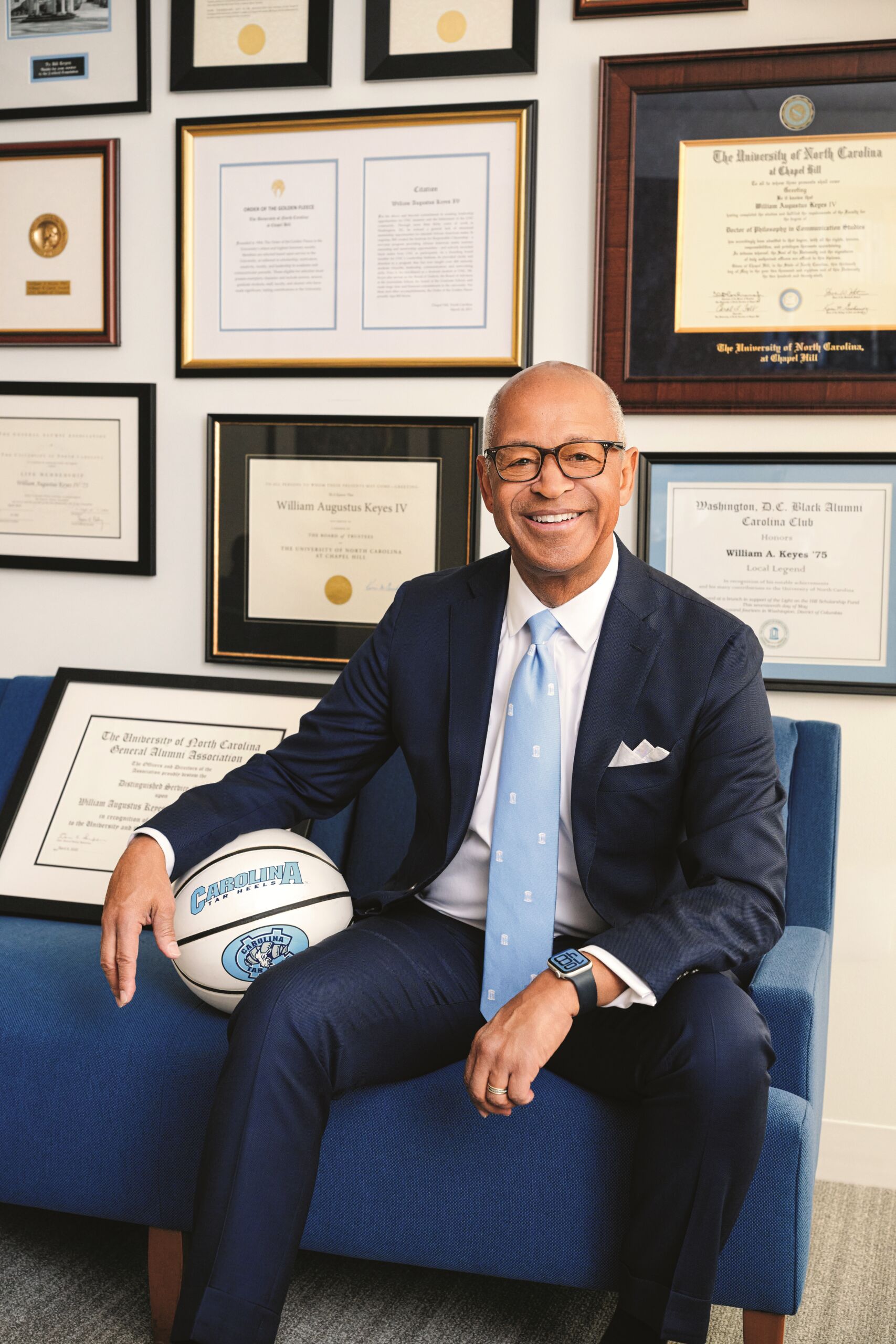
“The purpose of preparing the most talented young people for success is to increase their capacity for leadership and service to others,” Keyes said. “Preparing one excellent teacher, preacher or doctor benefits the hundreds or thousands of students, parishioners or patients whose lives that teacher, preacher or doctor will touch over the course of their careers. The most talented individuals’ success is not enjoyed by them alone.” (Photo: Eli Turner)
Today, Keyes is a Tar Heel insider’s insider. He serves on the board of directors of UNC Health, a $5.4 billion health care system, and previously served on the University’s Board of Trustees and its Board of Visitors. He’s been tapped for the Order of the Golden Fleece and the Frank Porter Graham Honor Society. He received the Harvey E. Beech Outstanding Alumni Award from Carolina Alumni’s Black Alumni Reunion. In 2022, Carolina Alumni honored Keyes with the Distinguished Service Medal, and he was one of four 2022 recipients of the University’s highest honor, the William Richardson Davie Award.
Yet what separates Keyes from the crowd is not his resume. It’s how quickly people smile when they see him. They detect his interest in them, and their gratitude shows. Wherever Keyes turns up, he talks to everyone as if it’s 1974 and he’s chatting up classmates in the Pit. Servers at the Carolina Inn know him. Acquaintances passing him on the sidewalk stop to update him on their lives. First-timers meeting him easily identify shared friends and promise to stay in touch.
A conversation with a Tar Heel basketball fan in 2006 opened the door to the PhD. The fan seated in front of Keyes at the Smith Center was Linda Dykstra, then dean of the Graduate School. “As is often the case when I meet fellow Tar Heels, we formed a meaningful relationship quickly,” Keyes said. They stayed in touch, initially focusing on recruiting IRC alumni to UNC for graduate school. When their conversations turned to Keyes’ own interest in graduate school, Dykstra connected him to the communication studies department. Within a few weeks, he was back in school.
Even now that Keyes has taken all the courses he can take and received all the awards UNC can offer, he remains under Carolina’s spell. “Bill couldn’t go through an entire conversation, certainly not 16 weeks with the scholars, without them knowing that he went to Chapel Hill,” Ganges said. “He refers to the color of the sky as Carolina blue.”
Turns out, you can take the man out of the Pit, but you can never take the Pit out of the man. “This is the only place I ever wanted to go to school,” Keyes said. “People apply all over the place. This is the only place I ever wanted to go. It really was a dream for me.” He said being on campus or even watching a sporting event on television still has a “physiological effect” on him. “I’m not just seeing something, I am feeling something,” he said. “When I come to Chapel Hill — I’m walking into the Smith Center or Kenan Stadium — I literally feel like I’m walking into a crowd of 20,000 or 50,000 of my friends and relatives. It just feels like family to me. It’s never changed.”
John Bare ’87 (’92 MA, ’95 PhD), a writer based in Concord, is the author of My Biscuit Baby, a novel set in Chapel Hill.
Thanks for reading the Carolina Alumni Review
Carolina Alumni members, sign in to continue reading.
Not yet a member? Become one today.