The Power of Yes
Posted on July 15, 2026Dan Morrison ’89 jumped at life’s rich opportunities. He’s hoping the next generation will join him.
by Andy Trincia ’88
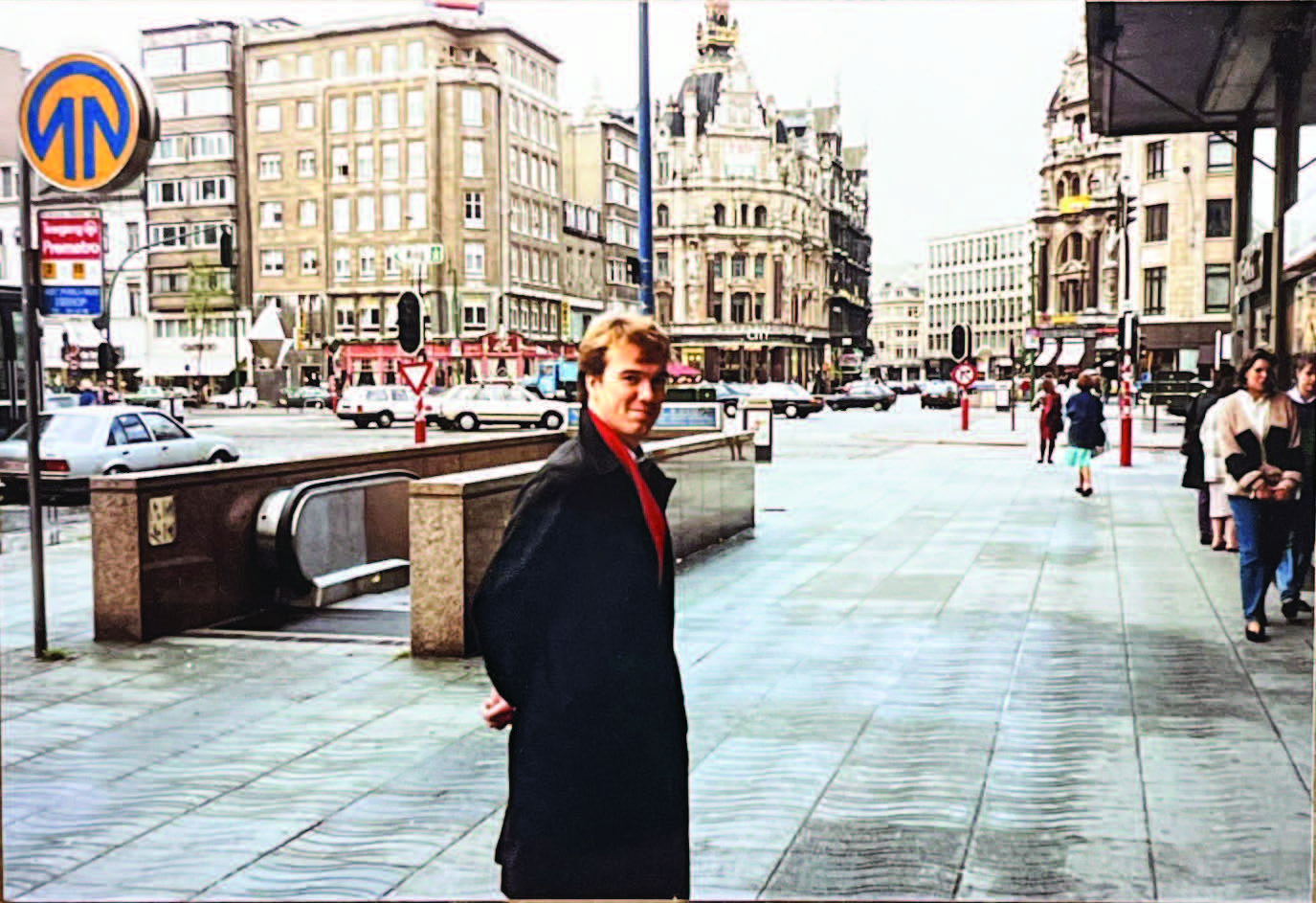
In Belgium, 1989, waiting on the Berlin Wall to fall
Two weeks after graduating from UNC, Dan Morrison ’89 hopped on a plane for Brussels. Seven months later, he found himself working at a public affairs consultancy and freelancing for The International Herald Tribune as the Berlin Wall fell, when he hitchhiked to Budapest with a Dutch guy he’s never seen again. A couple of years later, he drove to the former Yugoslavia as the Balkan War was erupting. Both experiences were about witnessing a fractured, new world unfolding.
Those exploits launched the next stage of Morrison’s journey, which began with a nomadic childhood and morphed into a successful career — punctuated with calculated risks on both sides of the Atlantic that continuously evolved as he pushed himself into uncharted territories.
He’s been a financial journalist, a speechwriter, a policy adviser and a communications and public affairs executive. He co-authored a children’s travel book with his son, published a technological thriller and penned an award-winning screenplay. He raises oysters on the Chesapeake Bay and has a food memoir ready for publication. He’s done several cross-country ski marathons, is part owner of a Danish professional soccer team and once trained as a dog handler in Alaska’s Iditarod Trail Sled Dog Race.
After decades spent globe-trotting, he now has his own advisory firm and works as an adjunct professor at Johns Hopkins University, where he integrates artificial intelligence (AI) as a critical thinking tool into his public affairs communications classes. He’s lived a life of teachable moments and seizing opportunities wherever he finds them.
“I’m a big believer in essentially saying yes to things,” Morrison said. “It doesn’t always mean you’ll get the result you hope for, but you’re increasing your odds while staying close to who you are.”
Upward trajectory
Morrison, 58, whose parents were the children of immigrants from Italy and Canada’s Nova Scotia, credits his carpe diem attitude to the family’s hardworking ancestors.
“I’m driven to make them and the ghosts of previous generations proud by fully tapping what I’m capable of and capitalizing on options that weren’t afforded to them,” he said. “Part of the drive is curiosity, and I’ve always felt that the day your curiosity dries up, it’s over.”
Morrison, who lives in the Old Town section of Alexandria, Virginia, just across the Potomac River from Washington, D.C., spent his early years in Michigan, Hawaii and Illinois, where as a paper boy he rose before the sun in frigid winters to deliver the Chicago Tribune, earning himself a 10-speed bike. When Morrison was in eighth grade, his family relocated to Winston-Salem where his father, Mike Morrison, a Vietnam veteran, took an executive communications position at R.J. Reynolds Tobacco Co.
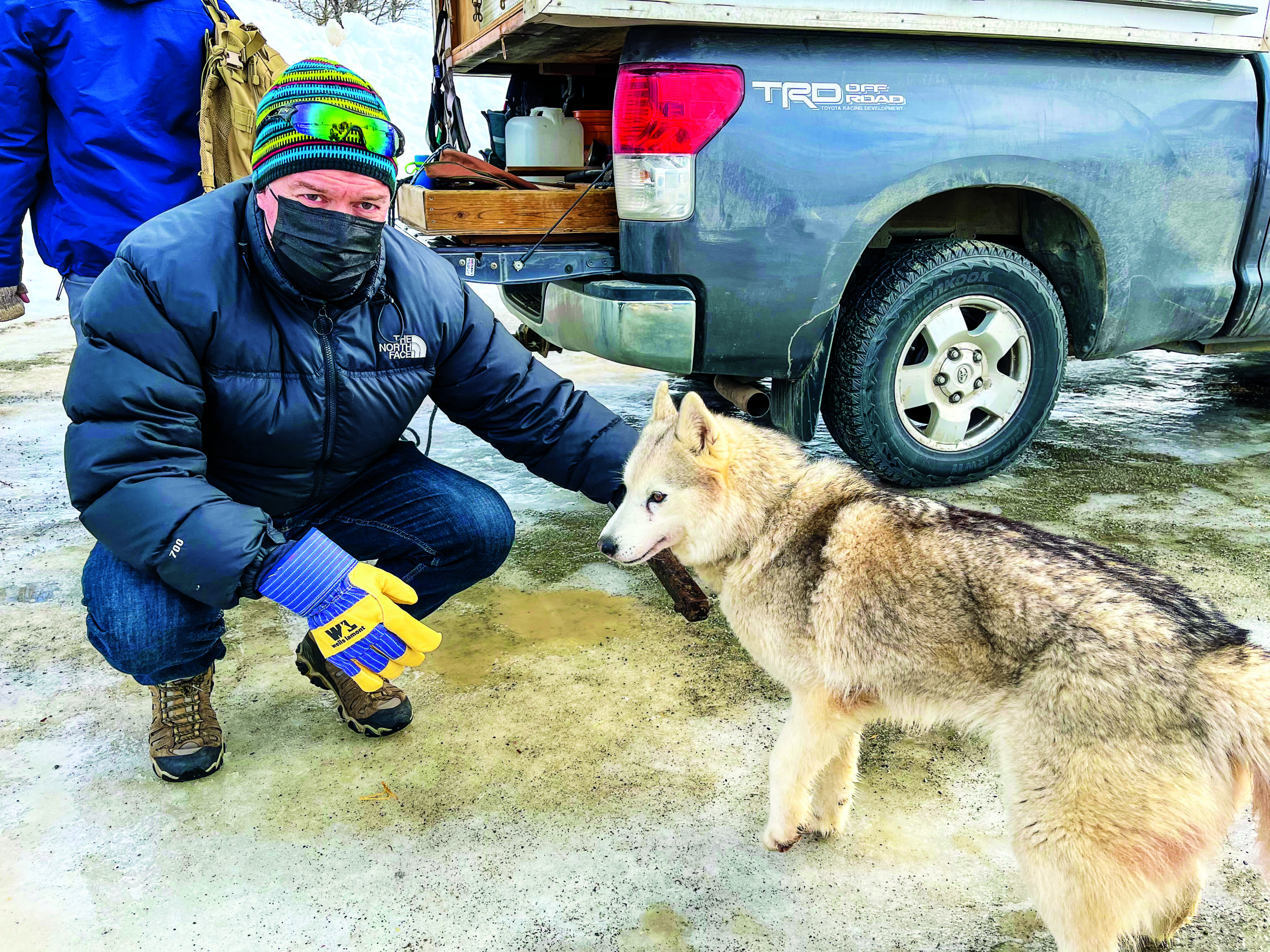
Readying for the Iditarod in Alaska
“In many ways, moving from Chicago to North Carolina was more foreign for me than moving from North Carolina to Europe later on — different religion, different accent, different way of life,” Morrison said. “But I grew to love it when I realized the talent that had either called North Carolina home or had hung their hats there for extended periods of time — people like O. Henry, F. Scott Fitzgerald, Thomas Wolfe [class of 1920], Maya Angelou, Nina Simone, John Coltrane, Charles Kuralt [’55], Joseph Mitchell [’29] and James Taylor.”
Morrison, a Catholic, thrived at Bishop McGuiness High School, where he respected the strong education of the Sisters of St. Joseph, edited the school newspaper, played on the tennis team, co-captained the soccer team and was selected for Tar Heel Boys State, a leadership program where students learn about government by creating and running a mock state. But the diverse student body, including some immigrants, piqued his curiosity about the world and molded his global view.
“Bishop McGuinness was a bit of an island of outsiders where everyone was welcome,” Morrison said. “It had earned that distinction, having integrated early. My friends were Catholic, Jewish, Protestant and Black, from all strata. I think it’s one reason I’m attracted to people … with stories that don’t parallel the mainstream. That’s where the good stuff is, where new ideas germinate, the marrow broth. And that carried over into my career.”
Morrison majored in American studies at Carolina, focusing on literature, choosing the University for its “word cred” and long list of notable alumni writers. He later went to the University of Cambridge in England to earn a master’s degree in international relations.
Despite a close relationship with his parents, he didn’t expect to follow in the footsteps of his father, who after working as a journalist and scoring a series of senior communications jobs became a speechwriter and confidant of legendary Chrysler CEO Lee Iacocca. But after Brussels and Cambridge, Morrison returned home to become a financial journalist at Bloomberg, where his coverage of the fast-changing telecommunications industry and dot-com bubble led the news organization to nominate him for the 1996 Pulitzer Prize. IBM noticed, and the struggling blue-chip corporation recruited Morrison to be a speechwriter for its executives.
“I’m a big believer in essentially saying yes to things… It doesn’t always mean you’ll get the result you hope for, but you’re increasing your odds while staying close to who you are.” — Dan Morrison ’89
After six years at Big Blue and enduring life in New York during the Sept. 11 attacks and aftermath, Morrison pivoted to D.C. and public service, joining the State Department, where he was a speechwriter for Secretary of State Colin Powell and then a senior policy adviser to the undersecretary of state for economic affairs.
Subsequently, Morrison, who by this time had married a Brit and had a son, moved to Paris to be head of media for the Organisation for Economic Co-operation and Development, a prominent intergovernmental group that fosters the exchange of economic policies and ideas.
After six years in the French capital, Morrison returned to D.C. to join the Pew Research Center as vice president of global communications, spending five years there until 2022, during which he helped expand its international outreach and audience strategies. Since then, he has maintained a frenetic pace as a consultant, mentor, adviser, writer and investor, often dashing across the Atlantic and comfortably straddling two continents. He is also on the UNC Board of Visitors, a position that has led him toward easy reflection about his time as a student at Carolina, where he refined the power of saying yes.
Understanding others
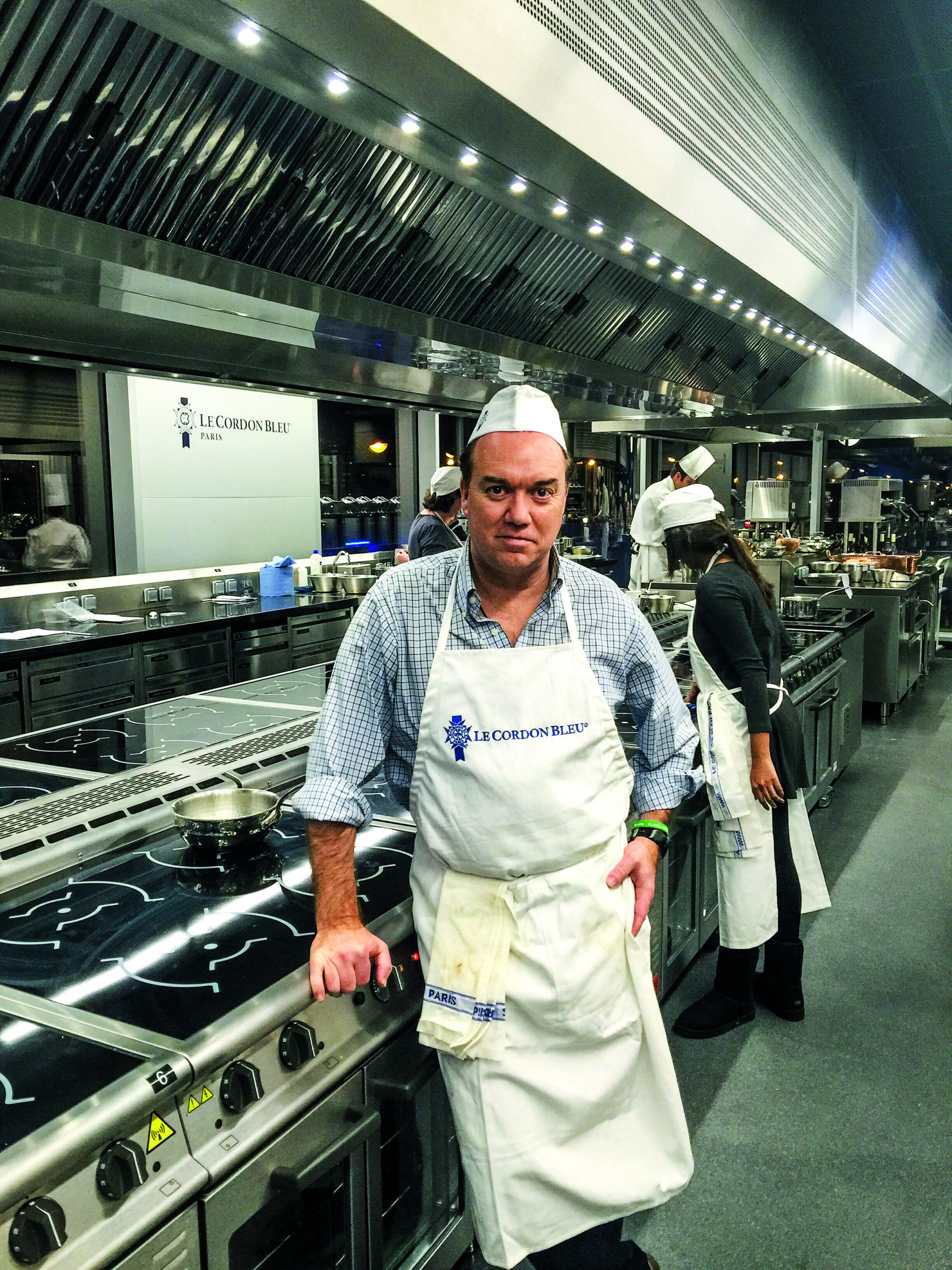
Cooking at Le cordon Bleu
As a child of the Cold War, Morrison has often found himself comparing American and Russian literature, including themes such as nature as a character. The act of understanding the other, combined with critical thinking skills that he honed in Chapel Hill and elsewhere, has stayed with him.
“In journalism, trying to understand others helps you get inside the head of the person you are covering,” Morrison said. “In speechwriting, it helps you assume the persona and vocabulary of the speech giver, and it helps you understand the audience. In public affairs, understanding others teaches you how to best communicate a message and to be predictive of your opponent’s counternarrative.”
Throughout his career, Morrison has leaned on this skill while advising several high-profile people and organizations, including the head of the International Monetary Fund, the Secretary-General of OECD and the Special Court for Sierra Leone that prosecuted former Liberian President Charles Taylor following the “blood diamonds” conflict during that country’s civil war.
As Morrison said yes to such opportunities for high-stakes collaboration, he learned to appreciate life as a series of moments that are either seized or let go.
The AI paradox
As a writer, Morrison could’ve thumbed his nose at the term artificial intelligence, but he’s embraced it. He had a front-row seat at IBM when the company built Deep Blue, which lost to Garry Kasparov in chess in 1996 before defeating the Russian master in 1997 — an early defining moment in AI. Today, Morrison integrates AI into his graduate-level classes because he feels, like it or not, it’s here to stay. He has spoken to organizations around the world about integrating AI into their workflows.
“My friends were Catholic, Jewish, Protestant and Black, from all strata. I think it’s one reason I’m attracted to people … with stories that don’t parallel the mainstream. That’s where the good stuff is, where new ideas germinate, the marrow broth. And that carried over into my career.” — Dan Morrison ’89
“I’ve seen this movie before,” Morrison said. “The general-purpose technology prequel to AI was the internet. There are a lot of parallels. I’m able to tell a story to my audiences, based on experience of what they can expect this time around.”
Morrison is fond of saying, “Tell your story before someone else does.” He believes that AI can be helpful for “storifying” — creating PowerPoint presentations and new forms of video and audio, for example — but the teacher or the speaker still has to deliver the story.
He views AI as an “interesting partner to promote critical, Socratic thinking,” allowing his students to use it, for instance, in the classic debate question. They pick a topic, give the supporting evidence and construct a counterargument with their own brain first. Morrison then asks students to use AI to help them bombard their original argument and find holes. He judges them on whether they used soft or hard prompts, which shows whether they really tried to stress-test their original argument, and whether they can spot “hallucinations” in the AI.
“Storytelling is trained on humans, not datasets, and is as much about listening as telling,” he said, “in a world that prefers black-and-white to gray and prizes what can be measured. I have a quiet confidence that storytelling always makes a comeback, even in our new AI era. I bet on that early in my career.” And he continues to bet on himself.
Yes, and …

Savoring a beer in the UK
Morrison’s most recent professional foray is in screenwriting. Pay Dirt, his first attempt at writing a movie screenplay, is about a CIA operative-turned-speechwriter who navigates D.C., Silicon Valley and Africa as the United States and China race to dominate rare-earth metals. The story is based on the unpublished sequel to his first novel, Bandwidth, and it won the 2025 Grand Jury Prize for best feature screenplay at the Richmond International Film Festival in Virginia.
His script, currently on the market for production overtures, has been a semifinalist at the Palermo International Film Festival in Italy, the Austin International Art Festival in Texas and the Calgary Indie Film Awards in Canada. It also gained attention at other film festivals last year in New York, Los Angeles, Atlanta and Belgium.
Writing sits close to Morrison’s soul. He was weaned on Ernest Hemingway, Rudyard Kipling, Jack London, Robert Service and John Steinbeck, among others. His father read Edgar Allan Poe to him and his brother at bedtime. Literature, he said, helps us understand what makes humans tick.
“Stories reveal universal truths,” he said. “I’m a fan of how history or philosophy can help us understand the world, but stories help us feel it, taste it, smell it.”
“Stories reveal universal truths… I’m a fan of how history or philosophy can help us understand the world, but stories help us feel it, taste it, smell it.” — Dan Morrison ’89
Morrison’s latest book, a food memoir titled Eating Off Other People’s Plates, is finished but not yet published. Chapters include adventures from Iowa to Botswana and points in between, including eating brown bear at a slivovitz-fueled wedding in Croatia; stumbling through the Scottish Highlands in search of blood sausage and scallops; eating lentils with Benedictine monks in a French monastery while listening to one of them read newspaper accounts of the French Revolution; bridging racial divides in Virginia over venison with a one-armed, octogenarian African American gardener; drinking martinis and eating duck confit with a Cajun-Thai chef in New Orleans; and slurping oysters everywhere he finds them.
“The book encourages people to take note of the living portals we pass through at these tables, which let us rehearse who we are and who we are always becoming,” Morrison said. “It’s about getting comfortable with the unknown and never judging without first tasting.”
Now that he’s around college students again, at Johns Hopkins, Morrison said he feels compelled to give life advice, not only the professorial kind. He encourages students, and others for that matter, to rethink the typical career trajectory.
“When I interact with students these days, I get the impression they think careers are a vertical progression, straight up,” Morrison said. “Nothing could be further from the truth. That belies discovery and taking the scenic routes that can enrich you.” To him, the best careers — not just his — are a combination of intent and serendipity, whereby you put yourself in the right situations and then pay attention to what happens.
“We’re on this marble for a short time,” he said, “and I prefer to make the weather.”
Thanks for reading the Carolina Alumni Review
Carolina Alumni members, sign in to continue reading.
Not yet a member? Become one today.