The Ram, The Myth, The Legend

Rameses, the ovine one, has served as Carolina’s loveable mascot for 100 years. While most of his history entails Tar Heel affection and adoration, it also involves strange, fanciful — even tragic — stories that together weave quite a baa-zarre tale.
Written by Allan Holmes ’83
Illustrations by Haley Hodges ’19
Prologue

Rameses’ history, given his namesake, wouldn’t be fitting without the tragic to go with the feel-good Tar Heel spirit. It’s part of the myth, the storyline of what Rameses means to Carolina alumni. (Photo: Carolina Alumni/Cory Dinkel)
Many of us have fond memories of seeing the lovable, wooly mascot Rameses peacefully munching grass at Kenan Stadium on Saturday afternoons. Or quietly posing with a fan for a photo at the Bell Tower. The ovine tradition has been around for generations of Tar Heels, and Nov. 8 marked the 100th year that Carolina’s endearing Dorset Horn ram has patrolled Kenan’s sidelines.
But just how well do we know his story? As it turns out, it’s one that belies the quaint, sweet-looking fuzzy mascot. It’s more fitting of a Shakespearean tragedy, replete with intrigue, patricide, a murder, frequent kidnappings, an enigmatic caretaker and a mythology built over the years. We don’t know exactly what the first ram’s name was, or how many Rameses Carolina has had, although the current mascot is Rameses XXII. We think. For unknown reasons, the first ram — purchased for $25 by then-head cheerleader Vic Huggins ’25 and introduced to Carolina students at a pep rally before the Nov. 8, 1924, game against VMI — was initially referred to in The Tar Heel as “Buckaneer.” (A possible connection: That year a campus humor magazine called The Buccaneer was first published.) Even the editors of the 1925 Yackety Yack misidentified him, calling him “The Battling Ram” — a mistaken reference to fullback Jack Merritt ’25, known as The Battering Ram, and who is the reason we have a ram as a mascot.
Just four days later, in a Tar Heel newspaper account of the VMI game, the mascot is referred to as Rameses II — not Rameses I — a choice that remains a mystery. One may speculate that students found the historical pharaoh Rameses II more appropriate than his father, The First, given that history considers the son one of the most powerful and successful warrior pharaohs in ancient Egypt. But we can only guess.

The confusion over the number of Rameses has been part of the lore and allure of the mascot
The confusion over the number of Rameses has been part of the lore and allure of the mascot, both good and tragic. The good: Just hours into his official capacity as mascot at the VMI game, Rameses II was on the sidelines when Bunn Hackney ’27, having been called into the game to kick a field goal, rubbed the ram’s head for good luck. Seconds later he dropkicked the ball through the uprights, giving the Tar Heels a 3–0 victory. The tragic: Just months later, in the summer of 1925, Rameses died after apparently becoming overheated in his pen in the basement of Caldwell Hall, the medical building at the time where dogs, stray cats, rabbits, guinea pigs and white rats were also housed to serve as “patients” for Carolina medical students. That was just a number of misfortunes to befall subsequent Rameses. The second Rameses died a year later. Another died when struck by a dairy truck, another from a headbutt from his son and another when an intoxicated hungry man stabbed him to death in search of food.
Rameses’ history, given his namesake, wouldn’t be fitting without the tragic to go with the feel-good Tar Heel spirit. It’s part of the myth, the storyline of what Rameses means to Carolina alumni. Here’s to 100 years of the Carolina-blue-horned Rameses overseeing tailgates, keeping watch on the sidelines and delivering smiles to hundreds of thousands of alumni and fans.
The Beginning: Buckaneer

A ram was chosen as Carolina’s mascot in honor of Tar Heel fullback Jack Merritt ’25, pictured here in 1989.
On Friday night, Nov. 7, 1924, in what was described by The Tar Heel as a “monster pep meeting” — “the largest ever held at Carolina” — students were introduced to UNC’s new “real live” mascot, a ram that the student newspaper cursorily referred to as “Buckaneer” and described as “a thoroughbred, a fighting, bucking, butting ram from Davidson county.” (Later reports indicate the sheep came from Texas.)
“In 1924, school spirit was at a peak,” head cheerleader Vic Huggins ’25 once explained. “But something seemed to be missing. One day it hit me. State had a wolf. What Carolina needed was a symbol.” The star fullback on the football team was Jack “The Battering Ram” Merritt ’25. So Huggins procured a ram, after convincing UNC Comptroller Charles Woollen (class of 1905), as in Woollen Gymnasium, to pitch in $25 to buy it.
At the pep rally, UNC Law School Professor Frank Rowley introduced the mascot, on which was draped “a blue and white saddle cloth of satin.” The newspaper paraphrased Rowley as saying “that from this time on, now and henceforth, forever, till death should call him, this Ram would be led before the team just before the start of every game and would be the mascot of the team, a Carolina rooter in victory or defeat.”

Cheerleaders pose with Rameses III at Kenan Stadium in the 1930s.
The next day, the newly lionized ovine was on the sideline at the game against VMI at Emerson Field, where Davis Library and the Student Union now stand. Apocryphal or not, the story goes that Bunn Hackney ’27 rubbed the head of the ram before entering the game near the end of the third quarter to kick a 20-yard field goal. It was good, and Carolina won 3–0. In a recap of the game in the Nov. 12, 1924, edition, The Tar Heel reported, “It was the first game for the new Carolina mascot, Rameses II, and he nobly preformed his duties and brought good luck and a win to the team.”
That article is the first time the ram is referred to as Rameses — but the paper reports his name was Rameses II, not The First, a possible nod to Ramses the Great, considered the greatest warrior pharaoh of ancient Egypt at the height of the empire’s power.
Just a few years later, the first Rameses would be commonly referred to as Rameses I, the beginning of a decades-long confusion over which Rameses Carolina actually had on the field.
Ramnapping

(Illustration by Haley Hodges ’19)
Over the decades, Rameses has been the target of several kidnappings or attempted abductions, mostly by N.C. State, Duke and Wake Forest students. East Carolina University students concocted one of the more elaborate and successful ram heists.
The first recorded Rameses kidnapping was in October 1942, about 10 days before the Carolina-N.C. State football game. Four N.C. State College students stole the mascot from the Hogan farm near Carrboro, where Rameses has been kept and tended to for decades. The theft was in apparent retaliation for Carolina students writing, in chalk, disparaging comments about the upcoming game on a building on State’s campus. In negotiations worked out by university administrators, Rameses was supposed to be returned within four days, with an agreement that a delegation of Carolina and State students meet over a turkey dinner at The Carolina Inn the day after the game to discuss how to alleviate “the tension between Carolina and State students caused by old and recent pranks.” It was serious business: Frank Porter Graham (class of 1909), president of the UNC system of public universities, was invited, but he was not reported as having attended. Three days before the game, State students returned Rameses, healthy and well-cared for, save for a vegetable-dyed red face and a painted Carolina blue rear. When the mascot was returned to Henry Hogan (class of 1924), Rameses’ caretaker at Hogan farm and a member of the 1924 Carolina football team, he told The Daily Tar Heel that if anyone tries to steal Rameses again he would “let go with some buckshot.”
State students tried again to kidnap Rameses in 1958, days before the Carolina-N.C. State game, but the Hogans thwarted the effort. Wary that Duke students might attempt to steal Rameses before the last game of the season in November, caretaker Glenn Hogan gave The DTH an ominous quote meant to frighten any would-be ’napper: “This is one of the most aggressive rams I’ve handled. In fact, he can be downright dangerous.” Described as big and mean, this mascot, reportedly Rameses VIII, was 8 years old and weighed a monstrous 250 pounds.
The 1965 football season was a perilous one for Rameses — and his flock. Days before the Oct. 23 game against Wake Forest, students from that university stole a ram from the Hogan farm. Possibly due to a lack of animal husbandry courses at Wake Forest, the students mistakenly nabbed the son of Rameses. They had planned to shave the young ram, paint his body black and his horns gold and then present him at a pep rally before the game. After learning they absconded with the wrong ram, the students returned him untouched.

Rameses’ history involves many abductions from rival schools.
Just weeks later, Duke students kidnapped the real Rameses, a serious enough plot that compelled Duke’s Dean of Men Robert Cox to get involved. He informed UNC Duke staff were looking for Rameses, and if they found him, the school would turn the mascot over to Carolina students. “We don’t want a bloody mess,” Cox said, a tone that hit vaguely sinister. Rameses, however, was returned safely.
Kidnappings continued into the 1970s, with East Carolina University stealing Rameses in 1975, stashing him away in “a fraternity house in Greenville where he lived on beer and pizza for a week,” said Don Basnight, grandson of the original keeper of Rameses. As a child Basnight frequently slept in the barn, guarding Rameses, albeit maybe not on this particular night in 1975. Rameses “showed up at the game painted in all purple.”
In 1977, Duke students again took Rameses. (Rameses IX, if you’re keeping track). This time, an organization called The Men of Operation C.R.A.P. — for Carolina Ram Abduction Plot — sent a letter to The DTH informing its editor of their mission and assured Carolina students and the Hogans “that your prize animal is in compassionate hands and that he will be treated with the utmost respect and care.” In what seems to be an attempt to keep heads cool, they added the abduction “was consummated in the healthy atmosphere of intercollegiate competition and rivalry.” At halftime during the game in Durham, Duke cheerleaders returned Rameses, with “D’s” painted on his sides and his horns Duke blue. With Rameses safely in the possession of Tar Heels on the sidelines, Carolina went on to win 16–3, earning its first ACC championship since 1972, and played in the Liberty Bowl in Memphis the next month.
In the decades that followed, Rameses abductions faded away, or maybe were just not reported. It’s impossible to know whether it was because students found the tradition less exciting or because the Hogan family introduced new security measures such as an electrified fence. But in the end, Rameses was never treated poorly, and the Hogan family took the thefts in stride. “It’s all been in good fun, and nobody’s ever hurt the ram in a school rivalry,” Ann Leonard ’82 (MSPH), who helps care for the rams, told The DTH a few years ago.
“Muddy death”
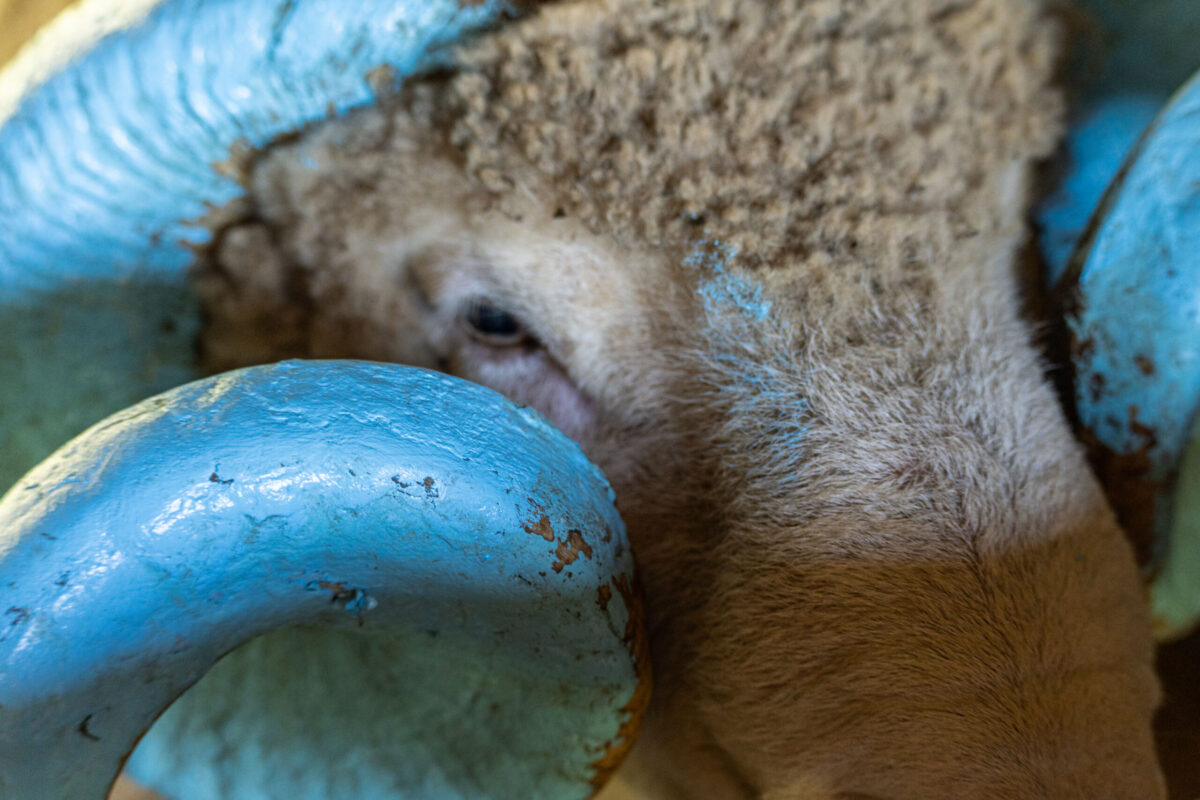
When not in Kenan Stadium or traveling to an away game, Rameses spends his days munching on grass in a pasture on Hogan’s Magnolia View Farm a few miles northwest of campus. (Photo: Carolina Alumni/Cory Dinkel)
Life isn’t easy for a ram, and the Rameses line has met its share of tragedy and bad luck. It started immediately, with the first mascot, Rameses II. In summer 1925, just months after making his debut at the VMI game the previous November, Rameses died of apparent heat exhaustion in the basement of Caldwell Hall, where different kinds of animals were kept in pens for medical students to work on during their studies. Less than two years later, in spring 1927, The Tar Heel reported the mysterious death of the second Rameses, and in 1929, another mascot died, presumably of old age, days before he was to be taken to Atlanta for the Georgia Tech game.
Years later, Rameses VII, as it was reported in The Daily Tar Heel (although by now the generational number sequence had certainly been confused), died in July 1952. Henry Hogan suggested the ram succumbed to the stress of an attempted kidnapping the previous football season. “If you ask me what killed Rameses, I’d say those Duke students worried him to death last fall when they chased him around the pasture all night,” he said.
Hogan also conceded the ram could have died from the summer heat or simply from old age. But the possibility of Duke’s involvement prompted the Blue Devils’ student legislature to send a long note of sympathy to Carolina, saying in part, “Whereas: The more spirited half of the Duke University student body has been mentioned as a contributing factor to his early and tragic death; Therefore be it resolved the legislature of the Duke University Men’s Student Government Association that an appropriate note of sympathy concerning the death of one Rameses VII be sent to our good neighbors in Chapel Hill.”
A note added to the official statement said, “Good luck up to, but not including, Nov. 22,” the date of the Carolina-Duke football game.
Life on the farm can be dangerous for livestock, including Rameses. In 1960, he was reportedly kicked by a cow but still appeared at the Carolina-N.C. State game wearing a bandage under his blue “NC” blanket. The next week he underwent a two-and-half-hour surgery to repair an abdominal hernia and missed the game against Miami. In September 1999, Ramrod, the son of the reigning Rameses and next in line to wear the blue blanket, died of an infection caused by a kidney stone. In the late 1980’s, Rameses was killed when hit by a dairy truck. In 2008, another Rameses died when his son, Pablo, head-butted him and broke off his father’s horn, causing an infection that took the elder ram’s life within days. The patricide allowed Pablo to ascend to the throne to become the next Rameses. How much more Shakespearean can you get?

Despite their checkered history, most of UNC’s Dorset Horn sheep live a relatively peaceful life, which, on average, last about 8 years or so, according to the Hogans. (Illustrations by Haley Hodges ’19)
Possibly the most gruesome death, which shook students, top University administrators and the Hogans, came in 1996. In February of that year, Rameses was found mutilated at the Hogan family farm. He had been repeatedly stabbed, gutted, his throat slashed and one of his shoulders cut off. The gory murder prompted then-Chancellor Michael Hooker ’69 to issue a statement saying, “The University deplores the horrible manner in which the incident occurred.” UNC Director of Athletics John Swofford ’71 also felt moved to comment, saying the murder was “very distressing to all of us.” In a bizarre twist two months later, a poster board — on which were drawings of a ram being sacrificed atop blue stones, two crosses, a bundle of wood and the words “mob,” “yellow” and “loving father” — was found in a briar patch on the Hogan farm. Students were fearful the killing was satanic in nature, but sheriffs immediately said it was not related to the killing. Months later, a 26-year-old Chapel Hill man pleaded guilty to killing Rameses, saying he was intoxicated and hungry. He paid fees totaling $767 and received a sentence of 18 months of supervised probation and 160 hours of community service.
The most recent death, that of Rameses XXI, was preceded by a premonition. On a winter Sunday night in 2021, James Hogan, great-grandson of the original keeper of Rameses, had a dream that the barn on the family farm was on fire, and he couldn’t extinguish it. The next morning, he looked out onto the pasture to see the sheep grazing in the sun as they usually do. But one was missing — Rameses. He found the ram, which had been retired the previous year after nearly a decade of mascot service because of arthritis in his shoulders and hips, lying on the floor of the barn, unable to get up. Rameses died that afternoon.
Despite their checkered history, most of UNC’s Dorset Horn sheep live a relatively peaceful life, which, on average, last about 8 years or so, according to the Hogans. When not in Kenan Stadium or traveling to an away game, Rameses spends his days munching on grass in a pasture on Hogan’s Magnolia View Farm a few miles northwest of campus. When he arrives home from a game, Rameses is greeted by his animal family. For example, when Rameses XX was away at football games, the other sheep and goats would stand at the gate calling for him, Ann Leonard, wife of the late Robert Hogan Jr., said in 2017. “They know he’s been gone, and they are waiting for him.”
Supporting Cast: Vic Huggins ’25

Vic Huggins ’25, with what may be Rameses VIII, in 1964 at a celebration of 40 years of Rameses.
Leonard Victor “Vic” Huggins ’25, head cheerleader at UNC, came up with the idea of a ram for a mascot. “My idea at the time was to deliver a mascot that would be unique and representative of Carolina’s play,” Huggins told The Daily Tar Heel in a 1964 interview. He was inspired by UNC fullback Jack Merritt ’25, who was nicknamed The Battering Ram.
“All our rivals had mascots,” Huggins recounted to The Daily Tar Heel in 1977. “I went to Charlie Woollen, the athletic director then, and told him that I wanted to buy a ram. He looked puzzled, but Old Charlie reached into his pocket and pulled out $25. The school might have reimbursed him later, but I believe it was a personal contribution.”
Huggins said Woollen was so taken by Rameses that the athletic director wanted the mascot to appear at basketball games in the Tin Can, where the team played at the time. The roar of fans at Rameses’ first game frightened him so much that he did his business on the floor. Huggins said he spent the evening with a whisk broom and flashlight cleaning up the mess. Rameses never attended another basketball game.
Huggins was described as “a living specimen of personified optimism” in his senior entry in the Yackety Yack, and he found an outlet for his enthusiasm in numerous ways. He composed, with Lonnie Sides ’24, the cheer “Here Comes Carolina ‘lina.” Huggins also was among the first in collegiate football to allow women to sit in the cheering section, which was unheard of at the time and drew sharp criticism from one alumnus who blamed Huggins for ruining the “UNC non-coeducational tradition.” When UNC won the Southeastern Conference championship in 1924, Huggins said he led more than 400 students in a march to Durham into the early morning hours, where they ate the “cafes plumb out of eggs and cereal.”
After graduation, Huggins taught civics and coached the drama team at Winston Salem Reynolds High School, leading them to a state championship and third place at the International Drama Festival in New York. He moved back to Chapel Hill and later opened Huggins Hardware store on East Franklin Street, which he operated from 1944 until the early 1960s and where he frequently greeted people on the sidewalk as they passed by. “He was a man of many interests, but most of all he was a great and good friend who gave life an added sparkle,” said William Friday ’48 (LLB), former president of the UNC System. Huggins died in 1989 at the age of 88.
Supporting Cast: Bushy Cook

In November 1949, Carolina played Notre Dame in Yankee Stadium, and Rameses made the trip to New York City with his handler G.B. “Bushy” Cook.
For the most part, the Hogans or cheerleaders have accompanied Rameses on the field. But in the late 1940s, an enigmatic character was seen leading the mascot onto the field and tending him at events. He was George Braxton “Bushy” Cook, a farmer from Efland and father of 11 who sported a long beard and a massive set of curls that gave him his nickname. He said he smoked extra-long cigarettes to keep from igniting his beard.
How Bushy became the personal attendant for Rameses for several years is not quite clear. Bushy told one story in which he appeared in a newspaper photo while in the stands at a Carolina football game, and the next day he was asked to appear with Rameses on the sidelines. Another one, which isn’t necessarily contradictory, told of then-president of the UNC System Frank Porter Graham (class of 1909), soon-to-be U.S. senator, asking a clean-shaven Bushy at the beginning of the 1948 football season “to come over to Chapel Hill, hold the ram and have a big time,” as Bushy said in a 1949 Daily Tar Heel article.
Bushy’s time with Rameses was anything but dull. During the 1949 football season, when Carolina was scheduled to play a highly ranked Notre Dame team at Yankee Stadium in New York, he packed up Rameses in a trailer painted Carolina blue and adorned with “27 rebel flags,” hitched the trailer to his “falling-apart car and rattled all the way to the big city,” according to The DTH. Bushy reportedly stopped traffic as he walked Rameses in Times Square. But Rameses didn’t bring Carolina good luck. The Tar Heels were soundly defeated 42–6.
The last recorded evidence of Bushy tending Rameses is 1955.
Supporting Cast: The Hogan Farm
Watch a video of what life is like today for Rameses on Hogan’s Magnolia View Farm, where the ram has been looked after by the family for nearly the entire 100 years of the UNC mascot.
According to one source, Henry Hogan was asked in the early 1930s to take care of the ram on his family farm, a departure from the living quarters of the first couple of Rameses, which were housed in the basement of Caldwell Hall, the medical building at the time. Not only was he on the football team when the original Rameses made his debut, but the Hogan family had started the farm in the mid-1700s and became one of the original three benefactors to help establish UNC when the family donated about 200 acres.
Caring for Rameses hasn’t always been easy. In the early 1950s, the number of Dorset Horn sheep began to decrease because N.C. State researchers (wouldn’t you expect) found a gene mutation in the sheep to make them hornless to avoid the sheep from injuring themselves or other sheep. Farmers took to the new variety. To keep the horned species going, the Hogans have bred many Rameses, but not every one is a direct descendant of the previous mascot. The current Rameses, a ram named Otis who was christened Rameses XXII in 2020, was bought from a farm in Virginia, because, well, the time never was quite right for breeding Rameses XXI, the Hogans said.
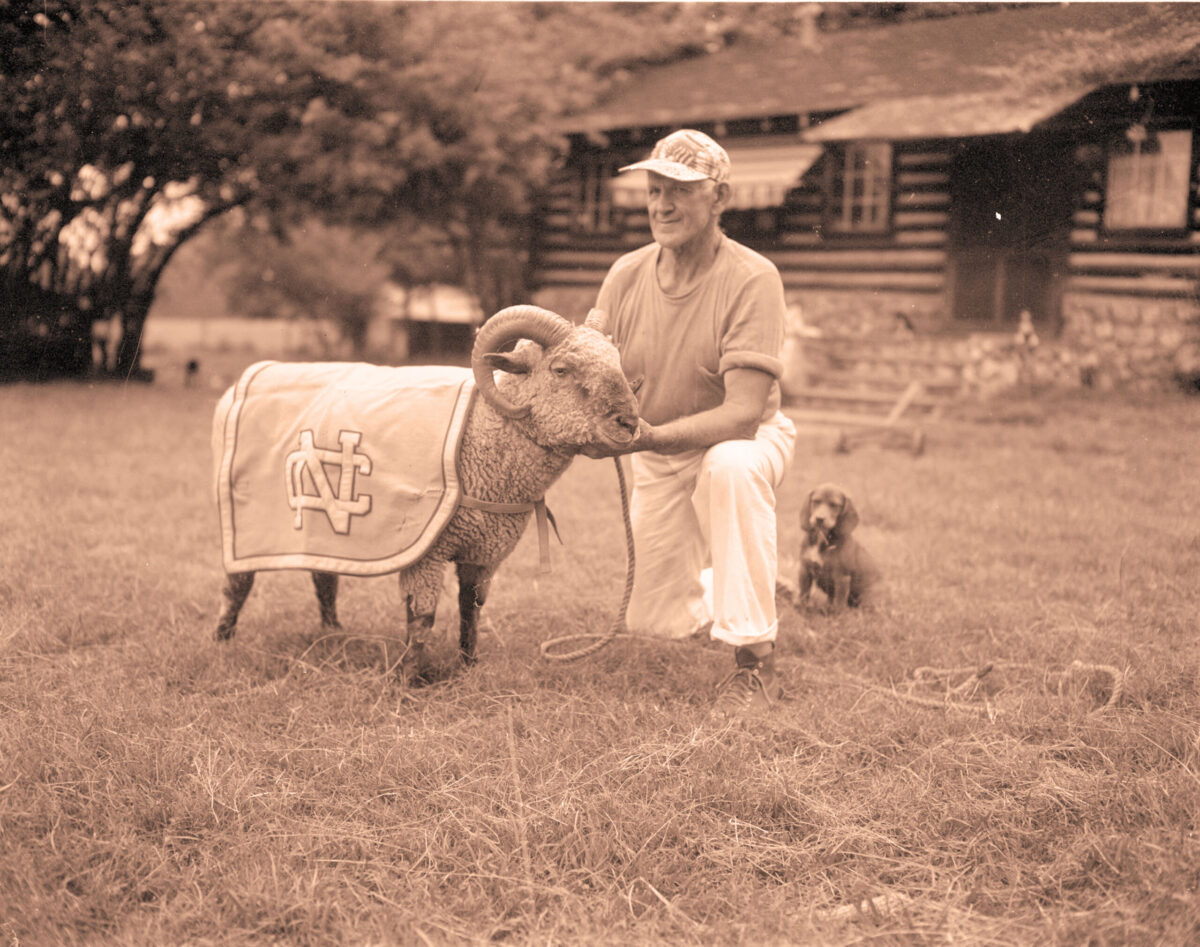
Glenn Hogan, whose family has now cared for the many Rameses for nearly 100 years, poses with one of the mascots in 1955.
A day or so before game day, the Hogans give Rameses a shampoo, turning his brown, dirt-filled wool a bright white, and his horns are touched up with Carolina blue paint, if needed. For almost 60 years, Rameses’ familiar blue blankets were sewn by Carolyn Hogan, wife of William F. Hogan. She started making the blankets, customized for each Rameses, because the first ones were “rather pitiful” looking, she told The DTH in 2017. “So I made him one and that started the tradition.”
To this day, drivers traveling in the evening hours on Hillsborough Road northwest of Carrboro can glance to the east and possibly catch a glimpse of Rameses grazing in the green pasture, the setting sun lighting up a pair of Carolina blue horns.
Thanks for reading the Carolina Alumni Review
Carolina Alumni members, sign in to continue reading.
Not yet a member? Become one today.