The Risers’ Edge
Posted on April 10, 2026From a snowed-out game in 2000 to this February’s nail-biter vs. Duke, 1,500 square feet of aluminum give the Heels a competitive advantage.
by Tim Crothers ’86
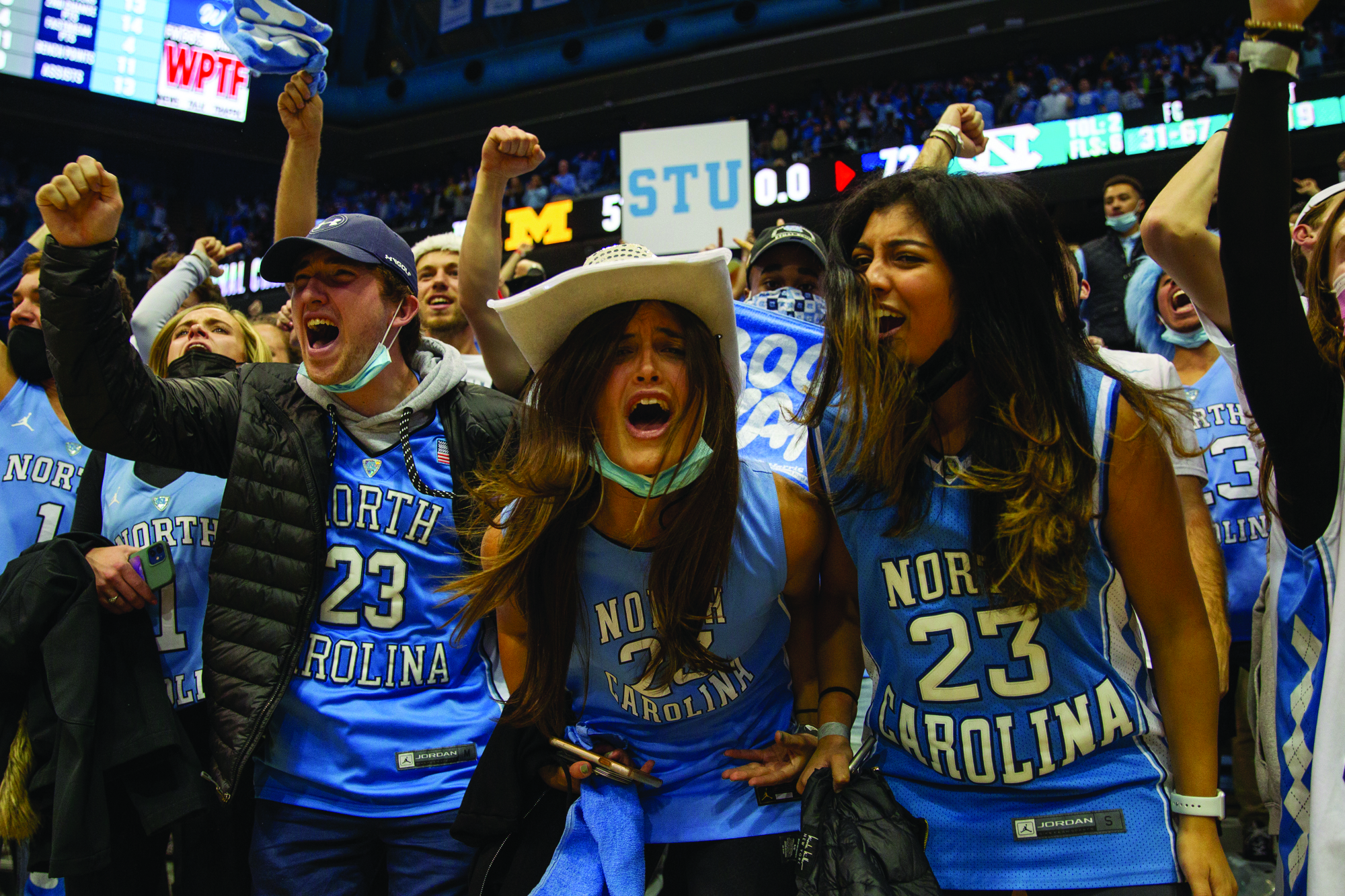
Wednesday, Dec. 1, 2021: UNC beat Michigan 72-51. (PHOTO: Carolina Alumni/Ira Wilder ’24)
Standing outside the Dean. E. Smith Center for several hours before the Duke game waiting for the privilege to go inside and stand for many more hours, I run into a Tar Heel stormtrooper. First-year Bradley Swayne is the son of two Duke grads, the grandson of two Duke grads and the great-grandson of one of Wallace Wade’s assistant football coaches at Duke. Swayne’s mother, Gayle Swayne ’97 (MSW), used to play cards as a kid with Eddie Cameron (yes, that Cameron). His older sister Katie, yet another Blue Devil, even snuck him in among the Cameron Crazies for a few games. “Growing up I was a Duke fan,” Swayne admits, clearly emphasizing the was. “But now Duke basketball is dead to me.”
For Bradley’s 15th birthday, Swayne’s grandfather, a Morehead Scholar at UNC before attending medical school at Duke, brought him to his first game at the Smith Center. It was, of course, the Duke game. Bradley’s teenage gaze was immediately drawn to the risers, a coveted standing-room-only student section directly behind the home basket. “I saw all those UNC students jumping up and down behind the basket, and I thought, ‘That’s pretty dope,’ ” Swayne says. “They were all decked out and crazy, standing right beside the court, and I just knew that is where I wanted to be.” On that day, UNC became Swayne’s dream school.
Three seasons later, Swayne lined up outside the Smith Center before the Duke game sporting a Christmas-morning grin underneath his stormtrooper helmet and a pair of Carolina blue-and-white-striped bib overalls. He and his roommate, first-year Sarp Ucer, both Star Wars fans, bought their helmets on Amazon and customized them with paint and Tar Heel stickers. They have specifically saved the helmets to wear for this game because in their minds the risers against Duke might as well be the red carpet at the Oscars.
The son of a Wake Forest physics professor, Ucer grew up a Demon Deacon fan, but he has also since converted. The roommates are risers regulars. “The risers are the only place to watch a Carolina-Duke game, because everyone in there is so hype that it feels epic,” Ucer says. “I don’t know who came up with the idea to cram hundreds of screaming students together behind that basket, but I’m really glad they did.”
Well, Sarp, it all began with a blizzard.
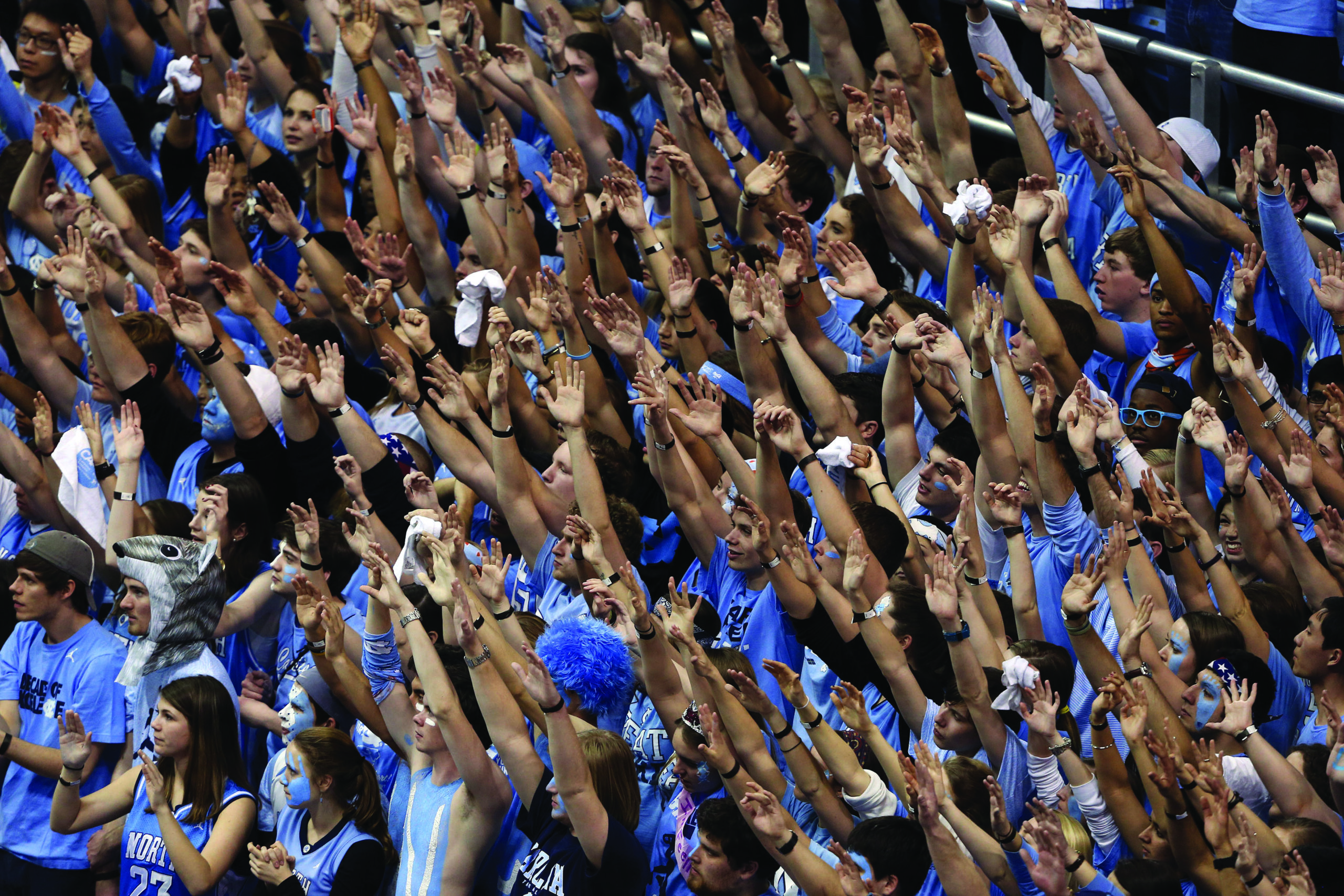
The official capacity of the risers is 350. Sometimes, like during games against Duke, it can be a little more crowded than that. (PHOTO: AP/Icon Sportswire)
On Jan. 25, 2000, a record 20 inches of snow fell on Chapel Hill. The Tar Heels were scheduled to play Maryland the following night, and the game was postponed until Jan. 27, when local travel conditions still hadn’t improved much.
A few hours before gametime, director of ticket operations Clint Gwaltney ’92 (now senior associate athletic director) phoned then-Athletic Director Dick Baddour ’66 (’75 MA) requesting to open the Smith Center to any fans daring enough to make the trek. Then-UNC junior Tee Pruitt ’01, the Carolina Athletic Association president, blasted an email to the full student body, prompting thousands of stir-crazy Tar Heels to slide, sled or tumble down Skipper Bowles Drive, eventually filling the arena’s lower bowl almost entirely with students.
At risk of their first five-game losing streak in nearly 50 years, the struggling Tar Heels trailed 22nd-ranked Maryland by seven points at halftime. But fueled by rabid crowd support from the students ringing the floor, UNC rallied behind 24 points from junior Brendan Haywood ’01 and won 75-63. Delirious fans stormed the court.
During postgame interviews, UNC players credited the students for sparking their comeback, and even Maryland coach Gary Williams said, “Not in this atmosphere. We weren’t going to put Carolina away tonight.”
Baddour said, “We all thought that kind of student support was wonderful. And it brought up again what we didn’t have. We didn’t have any students courtside.”
The CAA had been lobbying for courtside seats since the arena opened in 1986, but that game changed the narrative. “We pierced the veil that night,” Pruitt said. “We had a great win, and the students by the court clearly played a role in that. It started a bit of a groundswell. Without that game, the risers would never have been conceived. That night was the snowball — forgive the pun — that created an avalanche.”

Carolina began discussing the feasibility of creating student standing room behind the basket near the home bench, understanding that the Rams Club would have to agree to fund it, and certain donors would need to switch seats.
Preparing to enter the Smith Center for the Duke game, I ask junior Alexandra Myers about the best place to stand for my first-ever game in the risers. Myers explains that the vibe is different on each side of the basket. “I’m a left-sider,” she says. “I like being near the Carolina bench. It’s fun to see the reactions of the players when we hit a big shot.”
Junior Austin Kroll poses the counterpoint. “I’m a right-sider,” he says. “I might be biased, but I think the right side is more rowdy. We’re closer to the visitor’s entrance and we like to yell … stuff at them. It’s primal.” Unsure if I have primal in me, I opt for the left side.
One thing everybody can agree on is that a location directly behind the basket is the crucible of the damned. “Last year at the Duke game, I was able to get a good viewing spot in the risers, and there were two girls right behind the basket determined to move over to where I was,” junior Grant Bergeman says. “They started really flirting with me. I wanted to be chivalrous, but c’mon …”
Bergeman notwithstanding, the risers is a community that takes care of its own. There are no tickets, no way to keep track of who’s supposed to be where. It’s an honor system. Whenever someone flees for a bathroom break, their spot is dutifully guarded by those around it. While standing is the rule, except during halftime, the risers village even hides and shields the occasional rogue sitter during a timeout. It’s a society so inclusive that nobody at the Duke game bats an eye at the presence of a particular reporter three times their age sharing tintype tales of how the risers, much to their surprise, didn’t always exist in the Smith Center, and about his attending games in Carmichael Auditorium, which to them might as well be the Roman Colosseum.
The risers are a clown car at the circus, Black Friday at the mall, a giant game of Twister and a New York City subway at rush hour. As if there aren’t enough bodies jammed in there, just for the Duke game, the UNC cheerleaders are shifted to the sideline to allow for an extra row of students in the risers, bumping the official capacity from 350 to 400 (wink). The fire marshal must be on vacation.
Claustrophobia is just one reason the risers aren’t for everybody. To earn a place in the risers, you must also be an early riser. (Many of the folks in the risers for the Duke game queued outside the Smith Center in single-digit wind chills at 7:30 that morning, thus committing to remaining vertical for basically the entire day.) And it really helps not to be short. Identical twin sophomores Abbie and Zoe Falk both attended high school in Chapel Hill, often buying last-minute upper bowl tickets to UNC games and aspiring to one day stand in the risers. Trouble is they are both 5 feet, 1 inch tall.
“When we finally got to our first game as students in the risers, we were in a middle row on our tiptoes, and we couldn’t see a single play,” says Abbie, sitting three rows behind the risers for the Duke game. “The next game we got on the front row, but we were stuck behind this really tall cheerleader. That was a sign. We’ve chosen seats ever since.”
Two hours before the Duke game, legs already cramping, we spot UNC Athletic Director Bubba Cunningham dressed in a sport coat over an I (heart) Drake Maye T-shirt, high-fiving the entire front row of the risers. The first two Duke managers to emerge from the visitor’s tunnel are lustily booed (mostly by right-siders, of course). UNC sophomore Devin Duncan, a student body presidential candidate, works the room, dabbing for a group campaign photo. (Duncan would win the election a few days later.) A gaggle of girls behind me play I Spy to pass the final minutes before gametime.
When the strobe lights kick in and it is finally time to Jump Around, many of us can no longer feel our legs. The risers are truly a house of pain. Fortunately, we are packed so tightly that it becomes possible to elevate without your feet actually touching the floor. Is this what a rave feels like? As the hype music fades and the game prepares to tip off, junior Nick Hamilton turns to me sweaty, winded, beaming and says, “This is why we work so hard for the risers. I mean, where would you rather be?”

Feb. 1, 2000: The DTH’s editorial page cartoon set a throng of cheering students beside a dollar sign.
The morning after the snow game, a headline in The Daily Tar Heel read: “UNC Students Make Most of Trip Downstairs.” The story included a quote from one sophomore at courtside: “It’s usually a lot more quiet with the wine-and-cheese crowd. It’s a lot more energetic with the students here.”
Then on Feb. 1, The DTH published a front-page story titled, “Filling the Stands: UNC Students Say They Want Better Seats, But Officials Must Keep Their Eyes on the Cash.” In the story, Baddour explained that courtside seats couldn’t be taken away from Rams Club members whose donations built the Smith Center, and that a referendum to increase student fees to help fund the building had been voted down by students.
The DTH editorial page that day included a cartoon featuring a throng of cheering students with the caption LOUD beside a dollar sign with the caption LOUDER. Below the cartoon was an op-ed written by Pruitt. It was a crafty call to arms for UNC students and alums to stump for change. Pruitt built his case around an incendiary quote from Haywood after the Maryland game: “Other places like Duke and Virginia put the students right on top of you. Our students are basically in upper row XX. … Tonight they got to watch the game up close, and we really felt all their electricity. We just knew that we had to get tremendous support tonight for us to win this game, and they were definitely our sixth man tonight.”
Before subsequent UNC home games that season, Pruitt staged rallies for the cause outside the Smith Center, including one famously visited by UNC head coach Bill Guthridge. “Coach Guthridge was always very diplomatic,” Pruitt said, “but he told us we were great against Maryland, and he would love to have us play a bigger role in the crowd.”
Meanwhile, behind the scenes a movement was brewing. “Because the reaction of the students and the atmosphere at the snow game was so good,” said Senior Associate Athletic Director Steve Kirschner, “Clint and I got together and asked ourselves, ‘How can we get that again?’ ” Gwaltney and Kirschner discussed the feasibility of creating student standing room behind the basket near the home bench, understanding that the Rams Club would have to agree to fund it, and certain donors would need to switch seats.
That conversation eventually led to a pivotal lunch meeting that included Gwaltney, Kirschner and then-Rams Club Executive Vice President John Cherry. “My head immediately went to who is sitting in those seats,” Cherry recalled. “Can we really get them to move? It was a logistical challenge, and I was apprehensive at first because I knew it wouldn’t take much to sink the whole project.”
Cherry asked Baddour’s permission to begin contacting Rams Club members about changing the location of their seats to allow for the construction of a standing area that would become known as the risers. “There was a lot of horse trading going on,” Gwaltney said. “It started as a pipe dream, but as we started crunching the numbers we began to realize, ‘Hey, this might actually work.’ ”
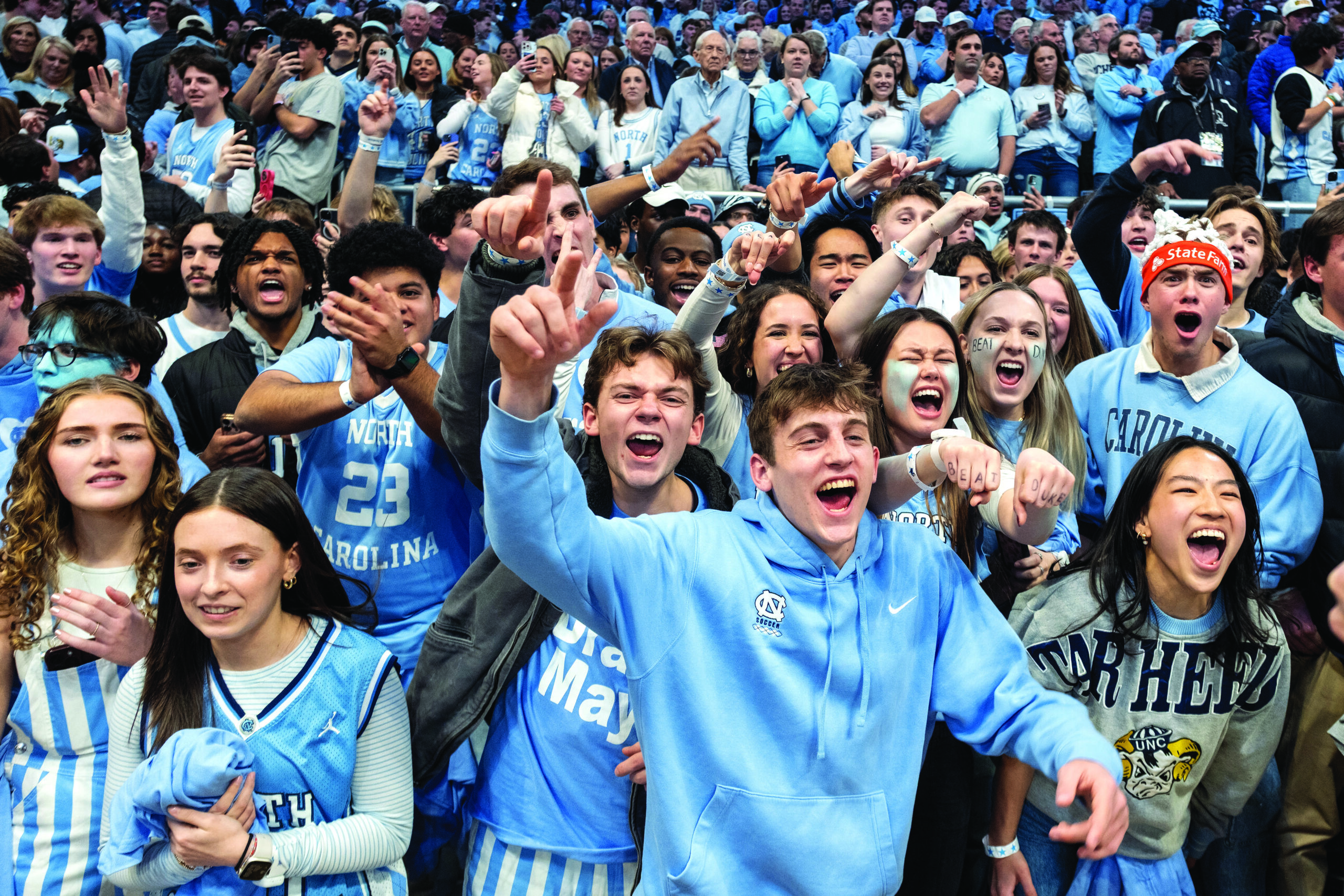
Saturday, Feb. 7, 2026: UNC beat Duke 71-68. (PHOTO: UNC/Jon Gardiner ’98)
Mackenzie Edwards and Hope Lee had never met. Edwards, a junior from Kill Devil Hills, had committed to play volleyball at the University of the South when in the winter of 2023 she was watching a UNC basketball game on television. “I know this is going to sound crazy, but the risers are part of the reason I decommitted and chose UNC instead,” she says. “It looked so fun in there that I wanted to come to a big school with a wild environment like that.”
When Edwards arrived on campus, she joined Carolina Fever to earn points toward guaranteeing her a place in the risers. (See “Catch Carolina Fever,” March/April 2024 Review.) She was #27 in Fever points before the Duke game and thus was able to procure a coveted spot in the front row.
During that same 2023 basketball season, Hope Lee watched Tar Heel games at her home in Rocky Mount with her mother, Lindsay Lee ’07 (MSA), the daughter always dreaming of following her mom to Chapel Hill. “Walking into my first UNC basketball game as a freshman, I remember some guy asked me, ‘Do you want risers or seats?’ ” Lee recalls. “I said, ‘What are risers?’ He told me that they’re behind the basket close to the UNC bench. I thought, ‘OK, yeah, that sounds awesome.’ And I have been in the risers ever since.”
Lee, now a sophomore, is a Carolina Fever volunteer, which afforded her access to the front row of the risers for the Duke game. She picked her favorite spot with a prime view of the Tar Heel bench and introduced herself to the girl standing to her left: Mackenzie Edwards. The two started chatting and quickly bonded over their shared interest in dance. They both sent photos to their mothers indicating their location so they could be spotted more easily on television, and each texted back and forth to their families at breaks throughout the game. During the tense final moments, Edwards and Lee held hands to help relieve their anxiety.
The following week, they would comment on each other’s Instagram posts. Lee wrote, Thanks for letting me hold onto you in stressful situations. Edwards would text Lee, asking if she’d like to stand beside her at future games. “What keeps crossing my mind is that we had a front row courtside view of a moment that’s going to go down forever in Carolina basketball history, and being able to share that together is just incredible,” Lee said. “That experience really bonded Mackenzie and me because you feel so close to the people around you that you have to talk to them and get your emotions out. Especially in a buzzer beater like that against Duke. You’ll never forget who you were standing with when that happened.”
Tee Pruitt stayed in Chapel Hill during the summer of 2000 just to be part of the many meetings that took place about the risers. “I remember walking out of the Smith Center after one meeting and running into Coach Smith in the parking lot,” Pruitt said. “He actually knew who I was because of all of this. He said, ‘Hey Tee, I really appreciate what you guys are trying to do. I think it’s really going to help the atmosphere.’ I was completely blown away.”
Matt Doherty ’84 recalled that, while playing for Smith in 1984, he signed a campus petition for students to get courtside seats at the soon-to-be constructed Student Activities Center. (The arena would not be christened the Dean E. Smith Center until Jan. 17, 1986, the eve of the opening game.) “Then I remember I was at the first game in the Smith Center, and I saw all the wealthy boosters sitting on the front row in their La-Z-Boy seats,” Doherty remembered. “I’d played in Carmichael with students screaming in the bleachers right behind the benches, and I knew this was not going to be as crazy or loud.”
Doherty would eventually replace Guthridge as UNC’s basketball coach during that summer of 2000 when the risers were approved. “That timing was perfect for me because when they put the risers in, it immediately brought more energy to the building,” he said. “It gave us more of a home court advantage.”
Cherry recalled spotting Pruitt standing in the front row before the very first risers game, Dec. 2, 2000, and the two exchanging a thumbs up. “The risers were completely jammed that night because everybody wanted to be part of history,” Pruitt said. “We felt like this was the beginning of something extraordinary.”
“I remember initially being amazed at the sea of humanity packed in there like sardines,” Gwaltney said. “When they all started jumping up and down, I was afraid the floor was going to break, but I knew this would become a fan experience unlike anywhere else.”
Twenty-five years since the risers were born, Gwaltney watched the final shot of the Duke game from his regular post in the visitors tunnel beside the risers. Kirschner sat just across the court at the scorer’s table and Baddour in Section 119. Cherry watched on television from his home in Florida. Pruitt would turn off his phone and experience the game fresh on tape with his son the following morning from their home in Munich. All five agreed that had it not been for a timely blizzard, the risers would not exist, and they all took some pride in the spectacle they’d helped create.
“It’s not lost on me that I was in the right place at the right time and just annoying enough in a friendly way to not let that idea die,” Pruitt said. “The risers are something tangible that I can point to and say that I was a small part of that, a nice reminder of my time at UNC that’s more than just a hazy memory. I may be long gone, but the risers are still there.”

When Carolina Athletic Association President Tee Pruitt ’01 (right) bumped into Dean Smith in the Smith Center parking lot one day, Smith told Pruitt he thought the risers would really elevate the arena’s game atmosphere. (Photo: Tee Pruitt ’01)
Y’all know what happened. And, yes, we stormed the court just like those brave souls after the snow game all those years ago. We actually stormed twice, and the second time I see the new friends Edwards and Lee rushing the floor arm-in-arm, Edwards screaming into her phone, “This is the BEST DAY EVER!!” I notice two Tar Heel stormtrooper helmets held high above the fray. And I bump into Grant Bergeman, who insists on a chivalrous bro-hug with this total stranger he’d met briefly six hours earlier. For this day, I feel like one of them.
A few minutes later, walking to the UNC interview room to visit with senior Seth Trimble, I recall a text I’d received out of the Carolina blue that morning from Tee Pruitt wishing me a good time in the risers, and I smile at the thought of him and his son asleep six times zones away about to wake up to this!
I ask Trimble about the risers. “Man, those guys were louder tonight than they’ve ever been in my four years here,” he says, still a little choked up in the moment. “They were our sixth man tonight, and I can’t wait to go to Franklin to thank them and party with them.”
I couldn’t help feeling blessed to have been standing in the risers just 20 feet from Trimble with a perfect view of the breathtaking moment when he became a Tar Heel legend forever.
Glad I was a left-sider.
Tim Crothers ’86 is a former senior writer for Sports Illustrated and teaches writing at the UNC Hussman School of Journalism and Media.
Thanks for reading the Carolina Alumni Review
Carolina Alumni members, sign in to continue reading.
Not yet a member? Become one today.