What Will Happen to the Dean Dome? Here Are the Top Options.
Posted on March 16, 2026After senior Seth Trimble sunk a last-second shot to defeat Duke in February and solidify his place in Carolina lore, it was little surprise — three weeks later — that the crowd erupted in applause when Trimble concluded his senior night speech with: “I really, really hope to see the Dean Smith Center here for a long, long time.”
The future of the arena that has housed Carolina Basketball for four decades became a hot-button issue when reports from The News & Observer, The Athletic and Inside Carolina suggested the University was preparing to announce the Smith Center would relocate to Carolina North, a plot of land nearly two miles north of Franklin Street that is slated to host academic, residential and mixed-use developments in the next decade.
Public opposition emerged in January from big names, such as former head coach Roy Williams ’721 (’73 MAT) and Tar Heel greats Tyler Hansbrough ’09, Brice Johnson ’16 and Drake Maye ’25, as well as more than 38,000 alumni and fans who signed a petition circulated by the Committee for a South Campus Arena, a group organized by former trustee Rusty Carter ’71.
In February, Chancellor Lee Roberts and Athletic Director Bubba Cunningham acknowledged they could have better communicated with the community over the past year. “Quite frankly, I think that we dropped the ball,” Cunningham told reporters.
Cunningham later said of the nod toward Carolina North, “As we floated that out, we said, ‘Whoa, whoa, whoa.’ It’s not just an economic decision. We need to take more time. There’s an emotional component … a logical component, and there’s a financial component. And so I think to the chancellor’s credit, he said, ‘Hey, let’s pause it here.’ ”
Since the pause, stakeholder groups comprising former players, trustees, students and donors have been meeting regularly with administrators to listen to updates and inform the decision-making process.
And in the name of increasing transparency with alumni, Cunningham joined the Carolina Insider podcast for “The Arena Discussion,” alongside Roberts, who addressed the ongoing situation regarding the Smith Center. In that first weekly segment on the Smith Center, Roberts said the aging arena needs significant investments to keep it operational, including replacing the roof, updating the bathrooms and bringing the building into compliance with modern accessibility standards. The University said these bare minimum repairs could cost around $153 million and result in a negative annual net cash flow.
“Before we spend that amount of money,” Roberts said, “we think it’s responsible to step back and make sure that we’re spending money as effectively as we can at a time when, as everybody knows, it costs a lot more money than it used to to field an elite college basketball program.”
Rather than simply repairing the infrastructure, what Roberts has called “a Band-aid approach,” the University is more seriously considering a comprehensive renovation to the Dean Dome, as well as two other top options — starting from scratch at Odum Village across Manning Drive from UNC Hospitals or at the new Carolina North campus, according to Senior Associate Athletic Director Rick Steinbacher ’93.
A new arena could be completed in time for the 2030–31 season, while a renovation to the Smith Center could be completed by 2028–29. The University plans to keep Smith’s name on the building and Williams’ name on the court, regardless of the arena’s location.
Giving the Smith Center a facelift would involve significantly expanding the concourse that currently creates shoulder-to-shoulder crowds exiting the arena after games and building state-of-the-art training facilities for both the men’s and women’s basketball programs. A renovation would also give the arena more premium seating options to boost revenue, and WRAL reported either a renovation or a new arena would feature more than 3,200 premium seats.
Such an extensive renovation would cost around $591 million , according to the University, and it would include updating the attached natatorium, home to Carolina’s swimming and diving programs. The option would be the second-least profitable of those under consideration, resulting in $4 million in annual net cash flow, not including revenue lost during the renovation, as the men’s basketball team would likely have to play in an alternate location with limited capacity.
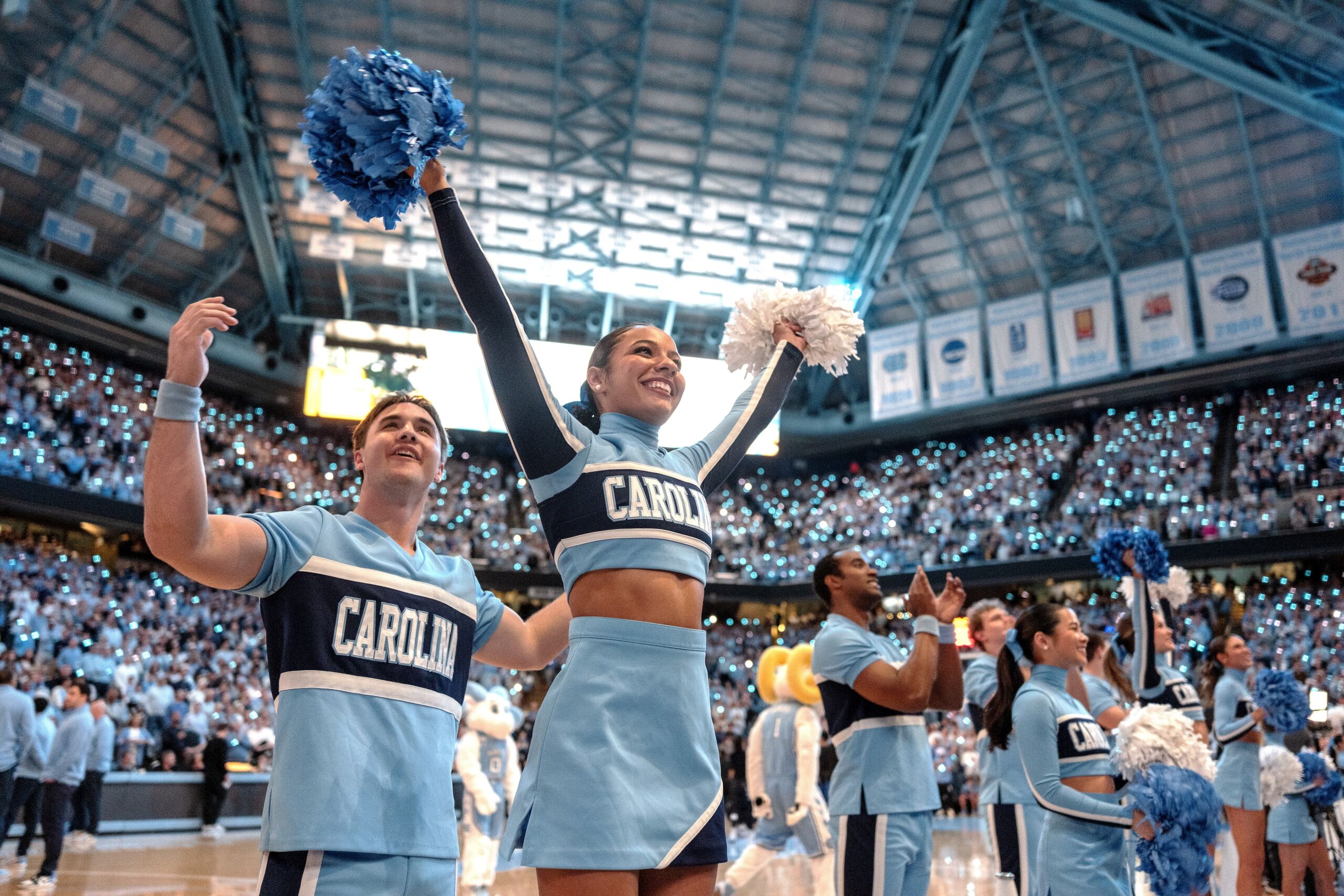
Duke Blue Devils vs. North Carolina Tar Heels men’s basketball game at the Dean E. Smith Center. February 7, 2026.
(PHOTO: UNC/Jon Gardiner ’98)
If the program were to play at the arena during a renovation, the project would be more expensive and slower. “In contrast, a new arena, whether at Odum Village or at the Carolina North campus, would be a blank canvas, so the University feels more confident in financial projections, construction timelines and their ability to offer premium fan amenities like multiple concourses and student tickets in the lower bowl,” the University said in an online news story.
Demolition of Odum Village, the former housing complex for married students, began in 2016 in an effort unrelated to the arena debate. The final standing structures of the original 47-building site will soon be knocked down.
University leaders identified the 14 acres of Odum Village, a short walk west of the Smith Center, as another feasible option on the University’s core campus. The N&O reported Steinbacher said he and Gordon Merklein, the associate vice chancellor for real estate and campus enterprises, drove around campus in 2024 hunting for other potential sites. They considered Fraternity Court, the student recreation center, the Rams Head Parking Deck, the Ambulatory Care Center and the EPA Human Studies Facility, each of which was ultimately considered unrealistic, according to The N&O, leaving only Odum Village and the Bowles Lot as contenders for a new on-campus location.
Building a new arena at Odum Village could cost approximately $703 million with an annual net cash flow of $25.1 million, according to University estimates, which did not include revenue generated from potential mixed-use development adjacent to the new arena.
And finally, the site of a former airport runway at Carolina North is the option that would undoubtedly give the University the most flexibility to build anything it wants — with no interruption to current basketball operations. It would cost about $786.46 million but would provide the highest annual net cash flow of the three options, according to the University. The estimate does not include revenue generated from mixed uses adjacent to the new arena.
Detractors to the Carolina North option lament the two miles between the site and main campus. Many also want to honor tradition. The Smith Center holds a special place in the hearts of many students and alumni.
Paige Masten ’21, deputy opinion editor at The Charlotte Observer, wrote in a March column, “If the goal is really to engage students, moving the arena further away from them doesn’t seem like the best way to achieve it. It would come at the expense of attendance and atmosphere.” Masten’s counterpart, Ned Barnett, associate opinion editor at The N&O, wrote, “Few foresaw where major college basketball is today. It’s hard to see where it will be tomorrow. Such uncertainty puts a premium on flexibility and adaptability. In that respect, the Smith Center, no matter how much it’s patched and renovated, would remain a dinosaur.”
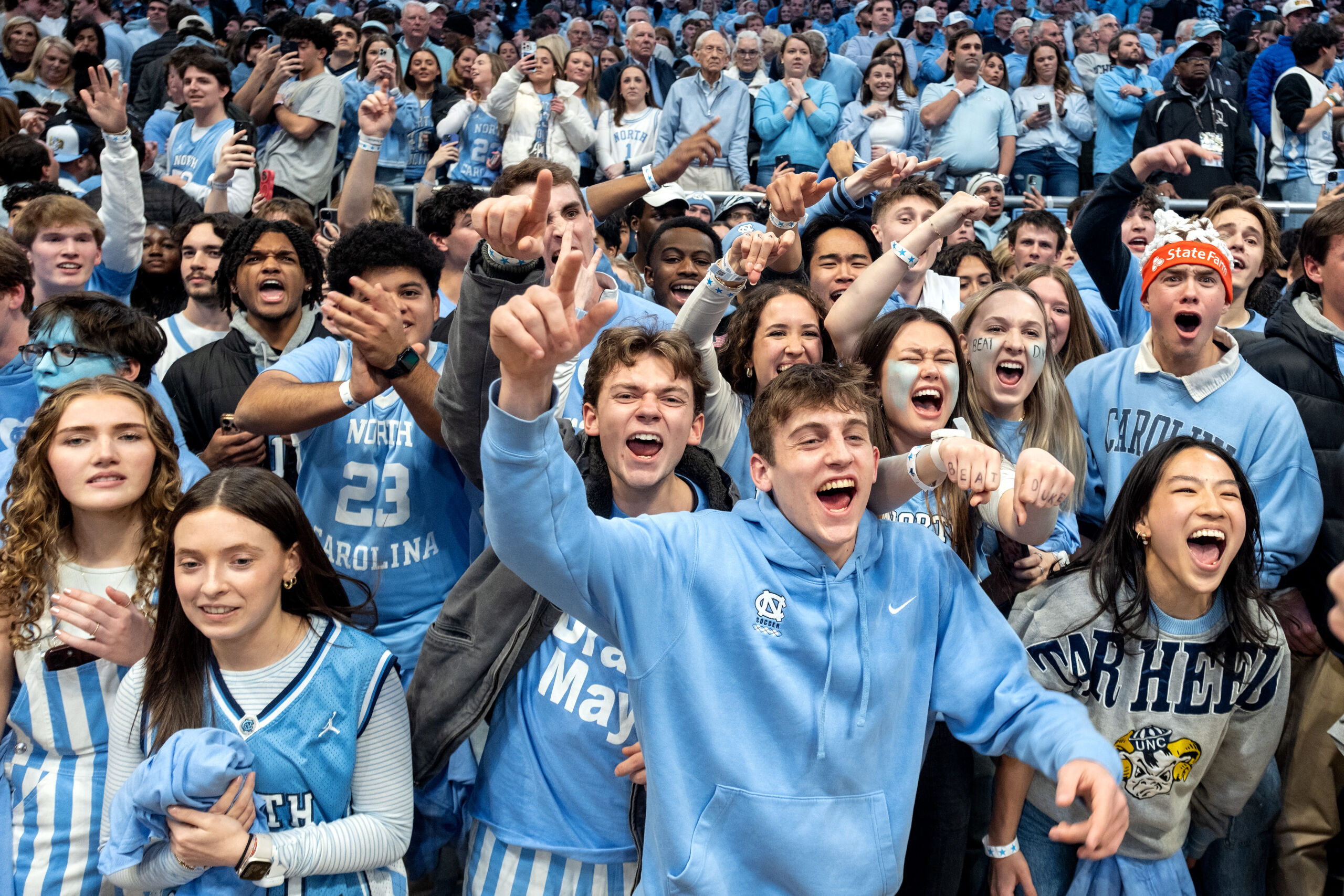
Duke Blue Devils vs. North Carolina Tar Heels men’s basketball game at the Dean E. Smith Center on the campus of the University of North Carolina at Chapel Hill. February 7, 2026. North Carolina won 71-68.
(PHOTO: UNC/Jon Gardiner ’98)
If the University builds a new arena, it is projected to house between 16,200 and 17,700 fans, several thousand less than the Smith Center currently boasts, in an effort to allow for wider seats and more leg room, premium seating, restrooms and concessions.
Cunningham said six priorities are guiding the decision-making process: increasing revenue opportunities, delivering a premier basketball-first collegiate arena, preserving the legacy and tradition of the basketball program, building best-in-class student-athlete training facilities, offering an elite fan experience and improving student seating for maximum in-game impact.
Though not an alumnus, Steve Newmark, who will become athletic director in July, grew up in Chapel Hill and recalled the atmosphere during games in Carmichael Arena, where the men’s team played from 1965 until the Dean Dome opened in 1986. For its modest capacity and low roof, Carmichael was known as one of the loudest arenas in the country. On an episode of “The Arena Discussion,” Newmark said Carmichael’s seating experience — where students essentially surrounded the court — is something he wants to capture in a renovated or new arena.
Student Body President-Elect Devin Duncan joined Newmark on the episode to discuss what students want from an arena, including proximity to residence halls and things to do close to the arena before and after a game. Carolina averages approximately 2,800 students per home game, though the number has been trending downward for 20 years.
The University said in an online news story, “Moving to a new arena would allow Carolina to construct the ideal student seating configuration from scratch, with an emphasis on the lower bowl. The Smith Center renovation model could alter seating configurations and would need to consider permanent seat rights holders and endowment donors, who will continue to play a vital role no matter which option is chosen.”
Permanent seat licenses, for donors who contributed to the campaign that paid for the Smith Center’s construction, still account for 4,357 permanent seats, 54 percent of which are located in the lower bowl, according to The N&O. The newspaper also reported endowment donors who bought into the Smith Center after its construction account for 2,100 seats, 81 percent of which are in the lower bowl.
“Some of them are incredible donors to the University,” Cunningham told WRAL. “Some are continuing to pay the minimum to keep the rights, and some are paying the minimum and then not even attending the games.”
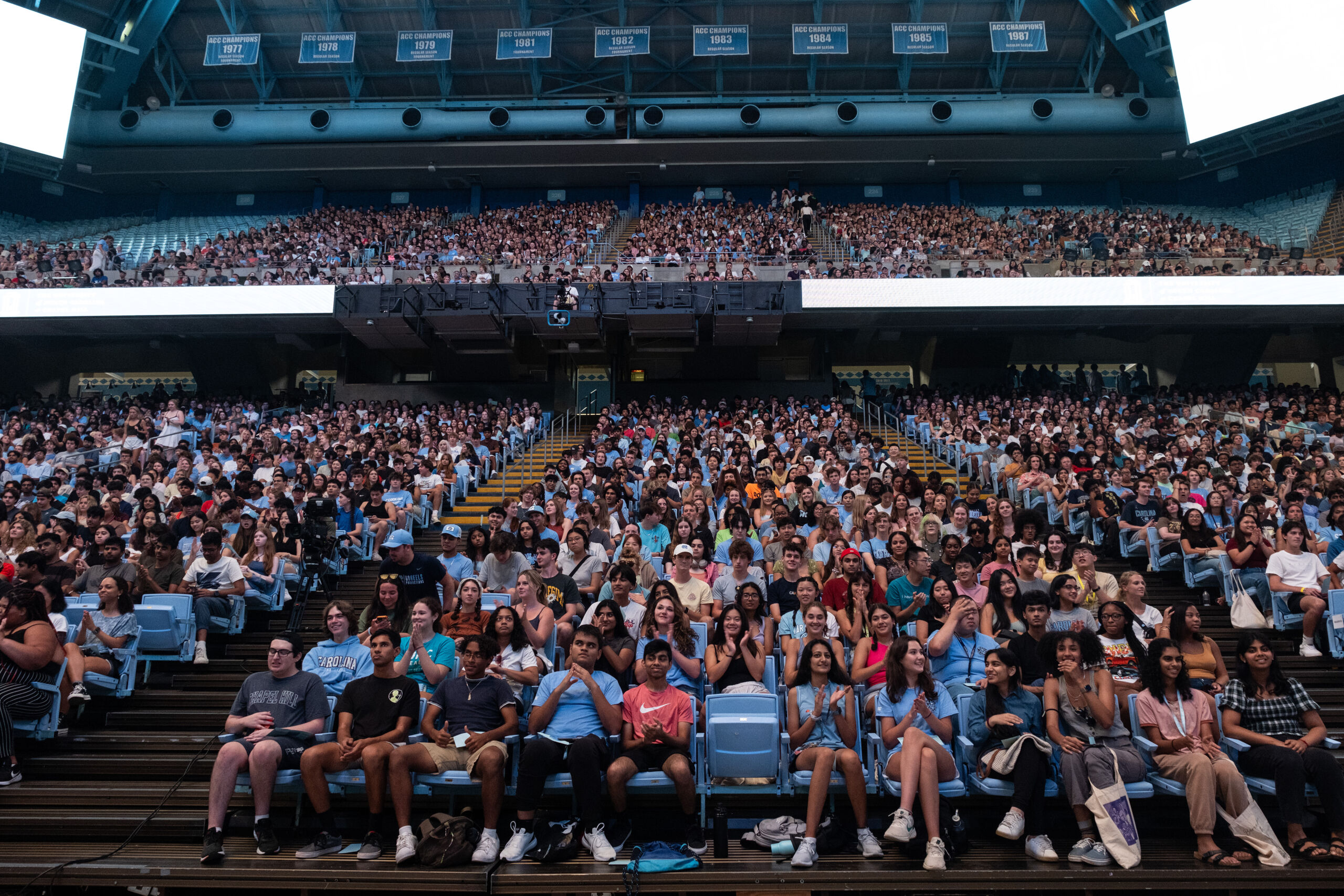
New Student Convocation held at the Dean E. Smith Center on the campus of the University of North Carolina at Chapel Hill. Monday August 20, 2023.
(PHOTO: UNC/Jon Gardiner ’98)
A renovation would produce roughly $14 million to $22 million less per year in revenue than building a new arena, a significant shortcoming considering the University paid its student athletes $21.5 million this academic year.
Revenue is more important than ever in the name, image and likeness era, when schools can directly pay elite talent through revenue sharing, and the threat of not being solvent enough to recruit elite talent looms large in many athletic departments. The schools that win the most games make the most money, share the most money with athletes, recruit the best players and then win the most games again. So, in the debate for the future of the arena, traditionalists have butted heads with those “bracing for college athletics’ business-like era,” as reported by Brendan Marks ’17 of The Athletic.
Carolina’s latest estimates suggest it would raise $404 million in capital gifts and philanthropy to build an arena, compared to $257 million to renovate the existing arena, assuming it fully honors permanent seat rights. The University is continuing to evaluate whether state money could offset the cost of each option.
WRAL reported the basketball program requires all season-ticket buyers to be members of The Rams Club, and most seats would require a capital gift, giving the donor rights to the seat for a decade. In that case, buyers would then also have to pay for the annual seat lease and the cost of the tickets.
“College sports are changing rapidly, and we have to figure out a way to stay true to our best traditions and honor our legacy while we continue to adapt,” Roberts said in the first episode of “The Arena Discussion.” “I didn’t know Coach Smith — I wish I did — but when I read about his legacy, that’s exactly what he did. Whether it was racial integration , the four corners offense or moving out of Carmichael to the Smith Center when circumstances called for it, Coach Smith was an innovator. And he responded effectively to how the world of college sports and college basketball was changing around him to make sure Carolina stayed at the forefront. That’s the legacy we need to fulfill.”
— Ira Wilder ’24