Writing Wrongs
Posted on Oct. 19, 2026
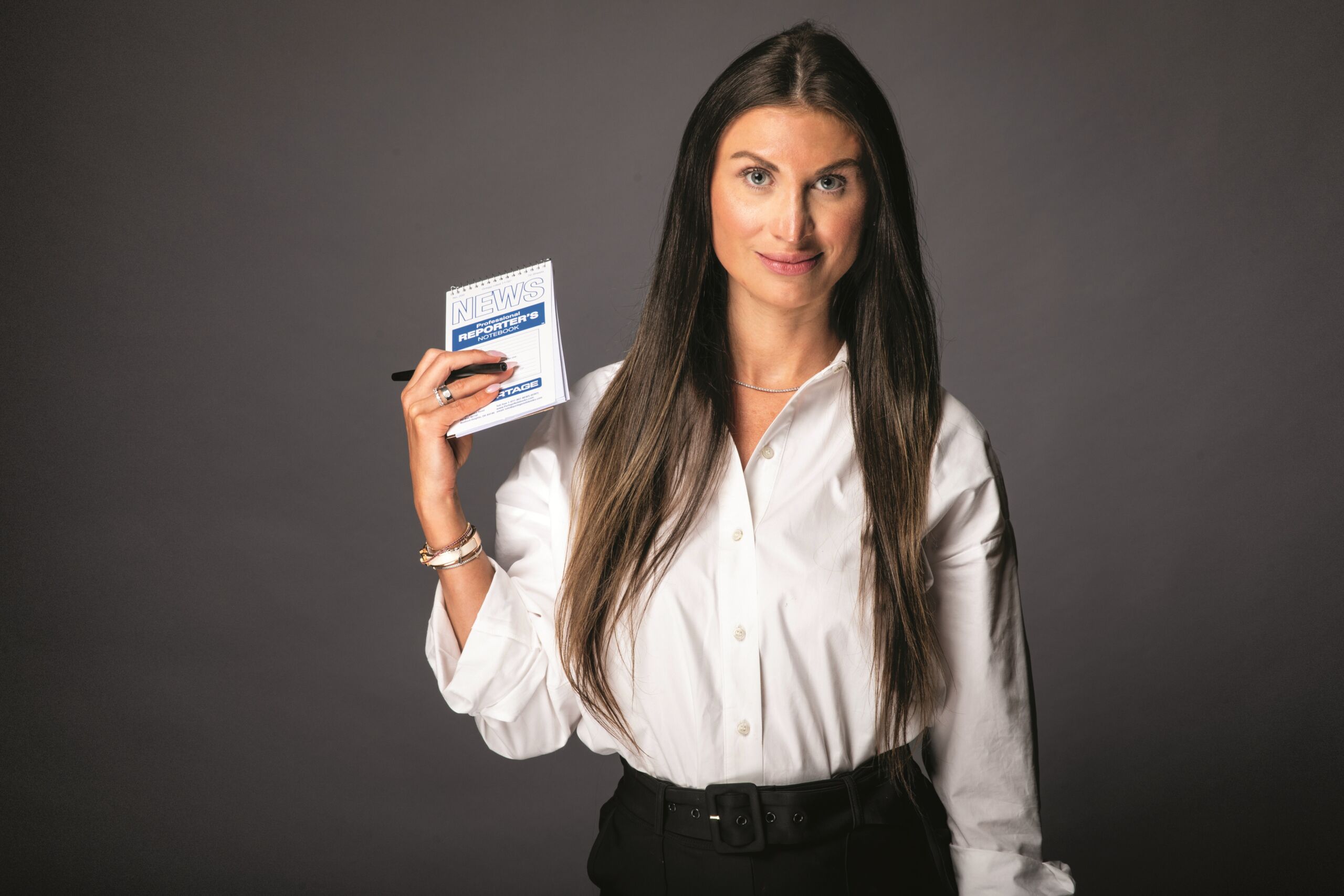
Madison Cavalchire ’16 is an investigative reporter for Crime Junkie, which is often the second-highest-rated podcast in the country.
On a freezing night in Michigan about eight years ago, a 23-year-old woman named Brittany Shank knocked on a stranger’s door, barefoot and bleeding. She asked for help, relaying that the man she was with had crashed their car. Soon after police were called, Shank ran off into the dark and was never seen again.
What happened to Shank — and to other cold case victims — is what Madison Cavalchire ’16 spends her days trying to figure out.
When people learn that Cavalchire is an investigative reporter for the most popular true crime podcast in the world, they often ask whether it’s hard, especially now that she has a year-old daughter.
After years working in local news, Cavalchire joined the company that produces Crime Junkie in 2023 and began investigating and writing about unsolved murders and mysterious disappearances. Some colleagues told her they couldn’t handle constant crime reporting once they had kids.
“I almost had the opposite response,” she said. “Now that I have a daughter … and wanting to know more about the world around me and help other people protect themselves, it’s almost made me more fervent in my own belief for justice.”
Even as she interviews the parents of those killed or missing, she said she compartmentalizes the gruesome details and reminds herself that her work may make the world a safer place for her daughter.
But, Cavalchire said, “It gets heavy.”
The Carolina Connection
-
- Over 800 species of plants
- 216 species of birds
- 67 species of butterflies
- 28 species of fish
- 23 species of amphibians
- 28 species of reptiles
- 29 species of mammals
Crime Junkie is the flagship program of the production company Audiochuck, which was founded by Crime Junkie host Ashley Flowers in 2017. It was one of the first crime podcasts to achieve mainstream success in what would become a saturated market and now reaches an estimated 6 million unique monthly listeners. Cavalchire is one of about a dozen writers who make Crime Junkie something people can’t get enough of.
She was one of those fans before she joined the team, listening to the company’s podcasts in her downtime while working as an instructor at Carolina and Duke. She taught introductory journalism courses during the pandemic and occasionally returns to campus as a guest lecturer. Prior to teaching, she worked as an on-camera reporter for CBS News and Spectrum News.
She’s not the mental image one might conjure of a sleuth: She’s less Jessica Fletcher and more professional cheerleader, which she was for the Carolina Hurricanes for three years as an undergraduate. But several years after graduation, she grew pessimistic about working as an on-camera reporter, turning and burning stories, chasing the daily news cycle for what she felt was little impact.
“I was a young girl feeling lost, knowing I wanted to stay in journalism, in storytelling, but feeling like I was so close to getting out of the industry,” she said. “I was so pessimistic about the state of local news and the ability to support myself. It’s a tough industry.”
She reached out to several women in media she knew through Carolina for advice. One was Delia D’Ambra ’14, who began working at Audiochuck in 2020. D’Ambra became a mentor, and the connection eventually led to Cavalchire landing a job with Audiochuck’s The Deck, which covers crime stories featured on playing cards circulated through prison systems. Law enforcement agencies replaced the traditional faces of the cards with images of missing and murdered people in hopes that the cards might generate tips among inmates. The cards tended to represent niche cases in small jurisdictions, cases that sent Cavalchire to remote corners of the country to blow the dust off forgotten case files.
“It was the best experience of my career,” Cavalchire said. “Getting to have my boots on the ground, covering these cases that no one knew about, and they got a lot of traction.”
Her reporting breathed life back into old cases.
“I truly believe that us knocking on law enforcement’s door and saying, ‘We’re doing this story,’ forced them to relook,” she said. In one case she covered for The Deck, her phone call to an investigator regarding a cold case sparked a revelation that law enforcement had yet to test decades-old biological evidence — evidence that wound up pointing to a suspect.
When Cavalchire returned from maternity leave last October, she was promoted to senior investigative reporter for Crime Junkie.
Episodes of Crime Junkie reported by Cavalchire include “MISSING: Christopher ‘Cole’ Thomas,” “MURDERED: Brittany McGlone,” “MISSING: Marilyn ‘Niqui’ McCown” and more.
Her story on Shank’s disappearance after a car crash in Michigan reached more than a million listeners in its first week. While reporting the case, Cavalchire unearthed a phone call from the day Shank went missing, recorded because it was between her and a man on a prison line. Though the case remains unsolved, the phone call, brought to light because of Cavalchire’s efforts, hinted at a potential motive in Shank’s disappearance and potentially brought the mystery one step closer to resolution.
Although the podcast is wildly popular, she said the team is less concerned with competing with The Joe Rogan Experience (the only podcast in the country that consistently outrates them) and more concerned with getting the story right.
Once Cavalchire finds a case to feature, she scours social media for sources, conducts interviews with law enforcement, reads old newspaper clips and requests public records, often including distress calls and crime scene photos. She gathers anything she can legally and ethically get her hands on, using the source material to weave an hour-long narrative. She said the median episode takes about a month to produce from pitch to air.
For most of the lesser-known cases she covers, there are no further public details on a case than what is reported in an episode of Crime Junkie. Thus, the script she writes will likely become the internet’s defining record of a victim’s life.
“When you Google this person’s name, this [podcast] is going to be the thing that pops up,” she said. “It’s a huge privilege, but it’s a lot of pressure.” In fact, if you Google Brittany Wallace Shank, many of the results on the first page are from Crime Junkie.
There’s a bit of a hushed guilt among fans of true crime content. Why is murder interesting? How could a podcast named something like My Favorite Murder, which is not affiliated with Audiochuck, be consumed in good conscience? Is it ethical to profit from a victim’s final story? When asked how she navigates those concerns, she said local news felt more transactional than true crime. At Crime Junkie, she has time to seek answers that can push cases forward.
“It’s not really for entertainment, but if we can get people to pay attention to the structure we’re using, the people we’re interviewing, the way we’re hooking them in, they’re going to remember that,” she said. “They remember to call the [district attorney] or to write the letter afterwards or to go sign the petition.”
When she talks to a victim’s friend or family member, Cavalchire knows that a captivating mystery to her listeners is likely a devastating ordeal for her source’s life. Without exaggeration, it’s the worst thing that’s ever happened to them.
Crime Junkie typically doesn’t cover cases without the support of the victim’s families, unless family members are suspects. In most cases Cavalchire has covered, families seek more attention to their case in the hope of finding resolution. She routinely calls families to review what she’s learned and ensure it sounds right. Sometimes she uncovers things families hadn’t learned yet. She said, “In a sense, we’re working for them.”
When an episode is released, even though she’s checked her facts dozens of times, she holds her breath sending the episode’s link to the family of the victim, hoping she did the case justice. Then, she starts all over. There are more cases to crack, families waiting for answers, and she’s not done asking questions.
— Ira Wilder ’24
Cavalchire credits Carolina with teaching her two things that made reaching her dream job possible: how to tell a story and who to call when you need help.
Of course, in any industry, she said, “if you know how to tell a good story and sell a good story, you are going to be successful,” but storytelling is only half of the battle.
“I feel really grateful for the women I met at Carolina,” Cavalchire said. “I’ve heard some of my other friends’ experiences as young women, and I never felt like there was any competition, any pressure.”
After D’Ambra connected Cavalchire with Audiochuck, Cavalchire did the same for Lorelai Sykes ’24, who joined the company after graduation.
Cavalchire said she feels a responsibility to pay it forward. “We lose a lot of talented women,” she said, “because in this industry it’s hard to support yourself.”
Thanks for reading the Carolina Alumni Review
Carolina Alumni members, sign in to continue reading.
Not yet a member? Become one today.