University Founder Davie’s Halifax Home Restored
Posted on Dec. 8, 2025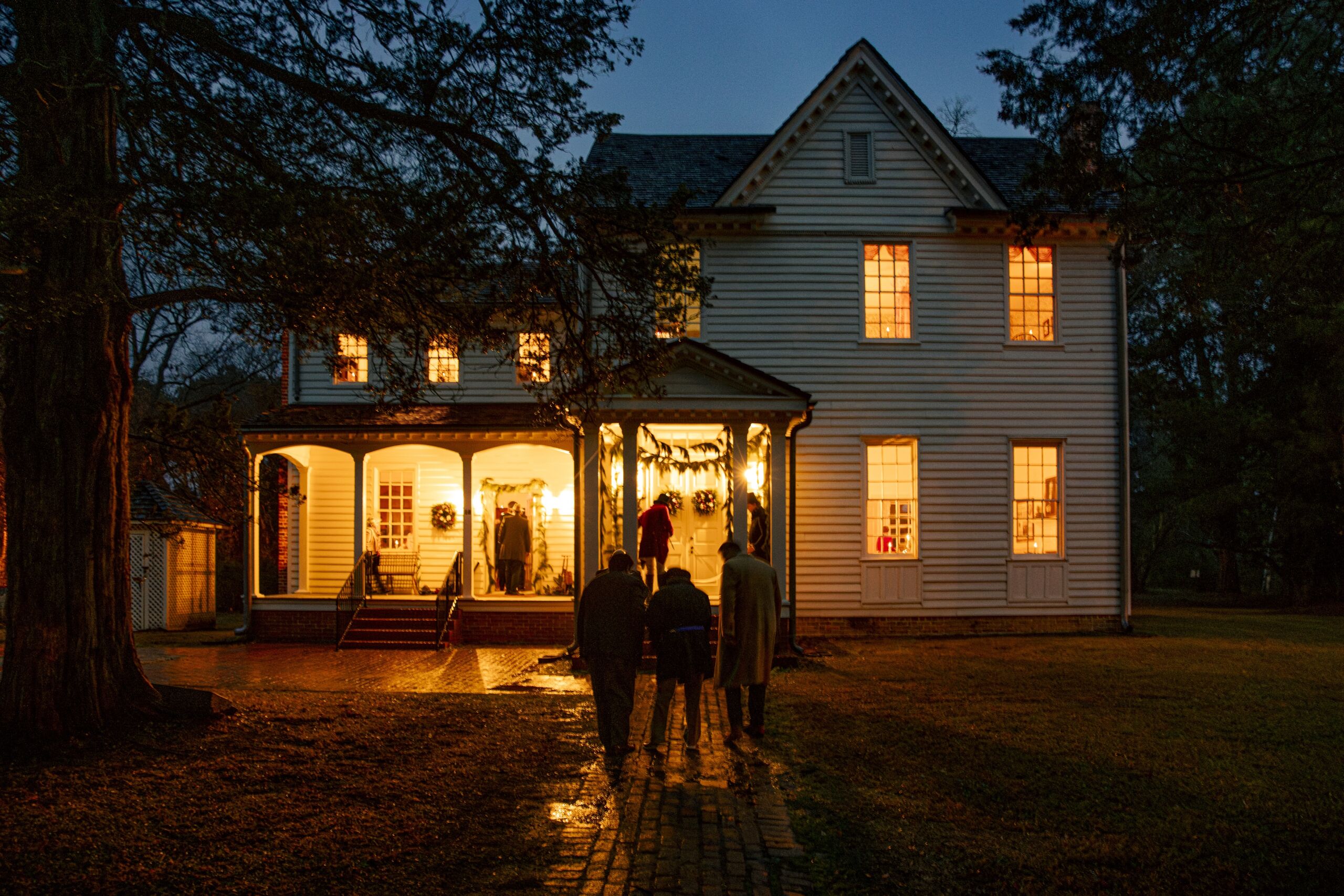
Historic Halifax welcomed community members Friday, Dec. 5, 2025, to the ribbon cutting of William R. Davie House. (Photo: Carolina Alumni/ Ira Wilder ’24)
About 235 years ago, William Richardson Davie hitched his horse to a poplar tree, sat in the grass for a summer lunch and had such a pleasant experience that he chose the forested land as the site for the newly chartered University of North Carolina. (Or at least that’s how the legend goes.)
Davie drafted the state bill that founded UNC in 1789 and is widely considered the “Father of the University.” But when he first tied his steed to what would become the Davie Poplar, he was a three-week journey away from his home in Halifax.
The home has stood all these years and was added to the National Register of Historic Places in 1973. It was sold to the State of North Carolina in 1999 after centuries housing families. On Dec. 5, after more than two decades of fundraising and construction, the house opened its doors to the public in a ribbon-cutting ceremony.
Historic Halifax Site Manager Carl Burke was thrilled to celebrate the restoration. “We’ve worked so hard to be here, and it’s been such a long journey,” he said. “It’s just so wonderful to see it all done and to see people enjoy it.”
The William R. Davie House, a Georgian Federal style townhouse, was built on five acres the English-born Federalist bought in 1783. Davie lived in the house for about 20 years, and he passed its threshold to serve in the North Carolina House of Commons, to attend the 1787 Constitutional Convention in Philadelphia, to become Grand Master Mason of North Carolina, to be elected governor of North Carolina and to serve as an envoy to France during John Adams’ presidency.
The restoration project involved removing and salvaging historic construction material, reinforcing concrete exterior wall footings, restoring original masonry and wood windows, repairing the house’s frame and running trim, replacing timber and wood flooring, removing and installing roofing, adding gutters and downspouts, repairing and replacing doors and frames, removing deteriorated paint, installing new ceramic tile floors and retrofitting plumbing and electrical systems. With every decision, the renovation team sought to present the home as it would have appeared centuries ago.
“It feels like the house is remembering itself,” said Michelle Lanier ’08 (MA), director of the N.C. Division of State Historic Sites. “I imagine there were times during Davie’s life this vestibule was full, just like now, and I imagine he stood right here giving remarks or greetings or blessings, just like in this very moment.”
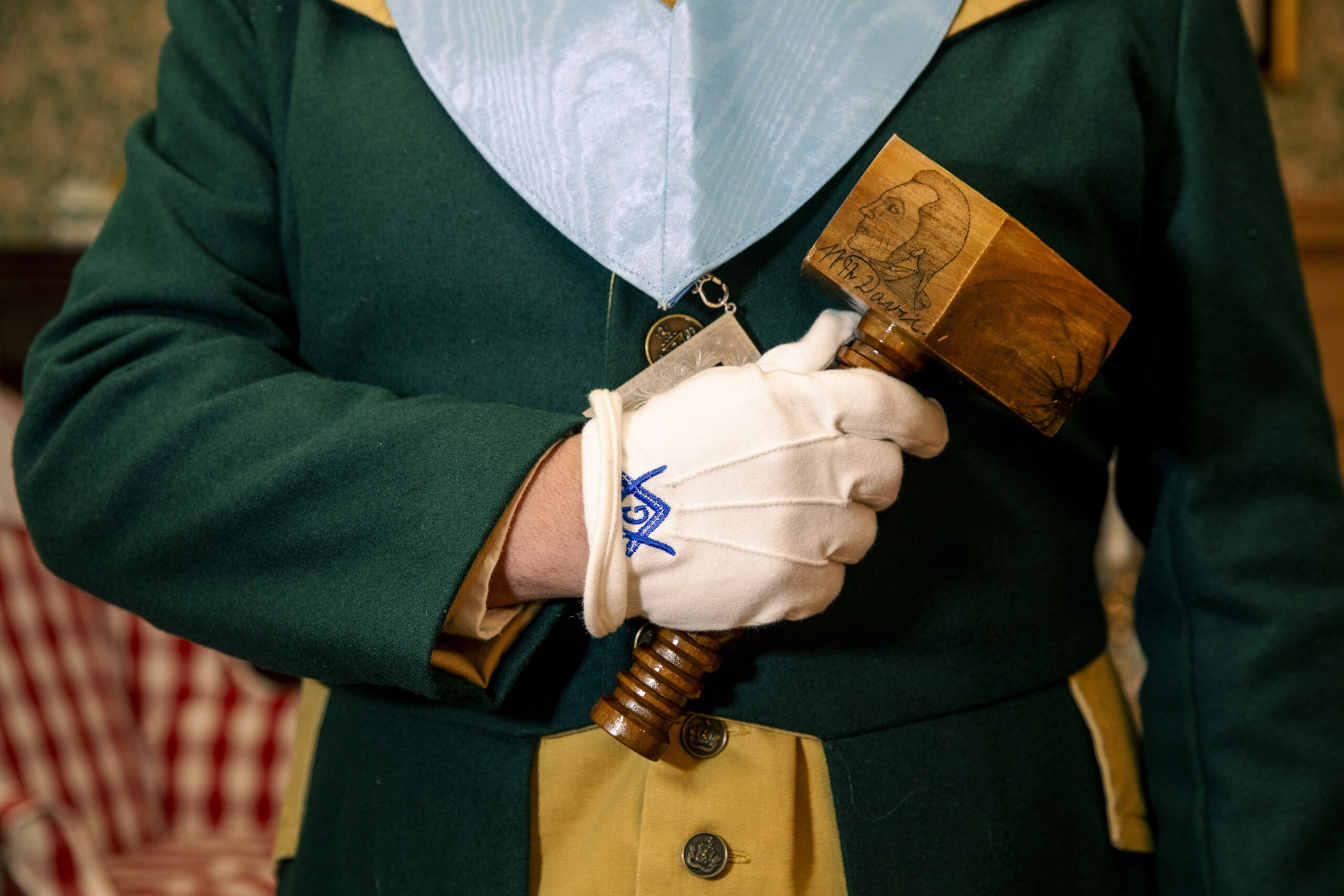
Hicklin, a Mason like his ancestor, dressed in colonial garb and wielded an inscribed gavel during the ribbon cutting. The gavel was fashioned from a fallen limb of the Davie Poplar. (Photo: Carolina Alumni/ Ira Wilder ’24)
At the opening, Jeremy Hicklin found himself especially close to the past: Davie was his fifth-great grandfather. Hicklin has been watching the house evolve for years, and he has a sliver of its original wallpaper framed in his home. He attended the ribbon cutting ceremony dressed as Davie, complete with a gavel made from a fallen limb of the Davie Poplar. (The gavel was purchased by the Lux Libertas Lodge, the University’s traveling lodge of Ancient Free & Accepted Masons, at auction for $2,850 this summer.)
“It’s like traveling in time,” Hicklin said. “He would have been standing right where I’m standing. To have that link and that connection to the past, it’s really just hard to put into words.”
The project was made possible by a $200,000 initial commitment by the late Nancy “Coley” James of Roanoke Rapids and later by more than $5 million in appropriations from the legislature. The Friends of Historic Halifax and the Colonial Dames of America provided further support for the project.
Community leaders hope the home will transport visitors back in time for decades to come. “Today’s dedication marks the care that has been taken to preserve and restore this place for the public,” Steve Norris, Grand Master Mason of North Carolina, said at the opening. “Historic Halifax has tied this home to interpretation, education and community life, exactly the kind of public-minded work that Davie himself repeatedly advanced in his career.”